Shandong Fengtu IOT Technology Co., Ltd
Sales Manager:Ms. Emily Wang
Cel,Whatsapp,Wechat:+86 15898932201
Email:info@fengtutec.com
Add:No. 155 Optoelectronic Industry Accelerator, Gaoxin District, Weifang, Shandong, China


Sales Manager:Ms. Emily Wang
Cel,Whatsapp,Wechat:+86 15898932201
Email:info@fengtutec.com
Add:No. 155 Optoelectronic Industry Accelerator, Gaoxin District, Weifang, Shandong, China
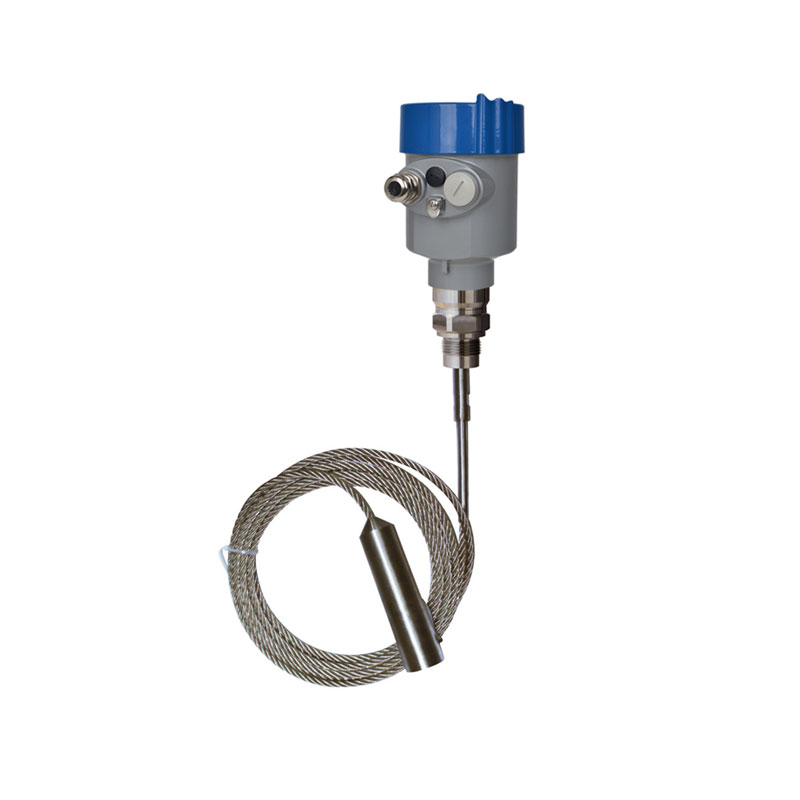
Model:JC-1.8B
Brand:fengtu
1.Product Principle of Guided wave radar level meter
Guided wave radar level meter provides reliable level measurement in both liquid and solid media, enabling continuous level measurement of liquids even under harsh conditions.The high-frequency microwave pulses emitted by the guided wave radar propagate along the detection components (steel cables or steel rods) and encounter the measured medium. Due to the sudden change in the dielectric constant, reflection occurs and part of the pulse energy is reflected back. The time interval between the transmitted pulse and the reflected pulse is proportional to the distance of the measured medium.
2. Technical parameters of Guided wave radar level meter
Applicable medium: liquid, solid powder
Application: Liquid and solid powder measurement, complex process conditions
Explosion-proof certification: Exia IIC T6 Ga/Exd ia IIC T6 Gb
Measuring range: liquid 0~20 meters, solid powder 0~10 meters
Frequency: 500MHz-1.8GHz
Antenna: Single cable antenna
Measuring accuracy: ±10mm
Process temperature: (-40~250)℃
Process pressure: (-0.1~4)MPa
Signal output: (4~20)mA/HART
On-site display: four-digit programmable LCD
Power supply: two-wire (DC24V) / four-wire (DC24V / AC220V)
Housing: Aluminum/Plastic
3. Guided wave radar level meter product features
The antenna is small in size and easy to install; it is a non-contact radar, without wear and pollution.
Almost unaffected by corrosion and foam; almost unaffected by water vapor, temperature and pressure changes in the atmosphere.
Severe dust environment has little effect on the operation of high-frequency level meters.
The shorter the wavelength, the better the reflection from inclined solid surfaces.
The small beam angle and concentrated energy enhance the echo capability while helping to avoid interference.
The measurement blind area is smaller, and good results can be achieved even for small tank measurements.
High signal-to-noise ratio for better performance even under fluctuating conditions.
High frequency, the best choice for measuring solids and low dielectric constant media.
What kind of equipment is tailwater monitoring equipment? It is a class of hydrological monitoring system that collects, organizes and analyzes various information in a water body. It has several characteristics as follows.1. it can automatically complete the whole process from the collection of raw...
Carbon monoxide is a colorless and odorless toxic gas. In coal mines, the incomplete combustion of coal will generate a large amount of carbon monoxide. Its ability to bind with hemoglobin is far stronger than that of oxygen, which will hinder the transportation of oxygen and lead to human hypoxia....
Radar level meter is an advanced instrument widely used in the field of liquid level measurement, especially in all kinds of storage tanks. It adopts a contactless measurement method, which can accurately measure the volume of liquid in storage tanks.The reason why radar level meter is widely used i...
The principle of ultrasonic wind speed and direction meter is to use ultrasonic time difference method to achieve the purpose of wind speed and direction measurement. The speed of sound propagation in the air is iterated with the speed of airflow in the wind direction. If the ultrasonic propagation...


 Get a Free Quote
 Skype
Skype
 whatsapp
 mail
mail