Shandong Fengtu IOT Technology Co., Ltd
Sales Manager:Ms. Emily Wang
Cel,Whatsapp,Wechat:+86 15898932201
Email:info@fengtutec.com
Add:No. 155 Optoelectronic Industry Accelerator, Gaoxin District, Weifang, Shandong, China


Sales Manager:Ms. Emily Wang
Cel,Whatsapp,Wechat:+86 15898932201
Email:info@fengtutec.com
Add:No. 155 Optoelectronic Industry Accelerator, Gaoxin District, Weifang, Shandong, China
time:2025-01-09 10:09:16 source:Weather Station viewed:831 time
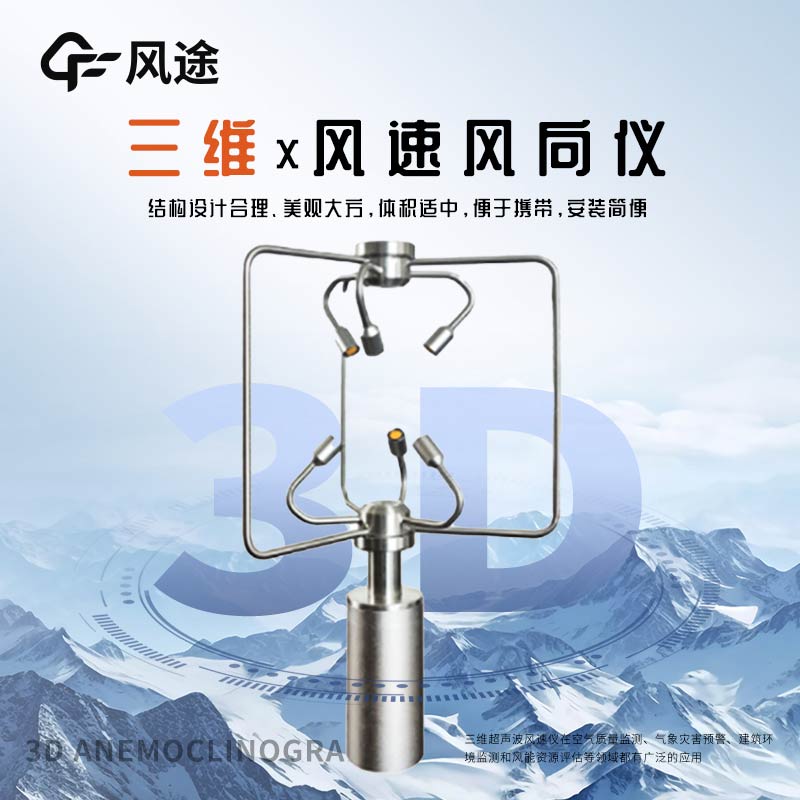
Within the scope of meteorology, wind speed and direction, as key meteorological elements, are of great significance to human production activities. Most traditional wind speed measurement methods and instruments can only measure two-dimensional wind speed. However, wind speed is actually a three-dimensional vector, and in terms of accuracy, three-dimensional measurement results are more accurate. Therefore, it is very necessary to conduct research on three-dimensional wind speed measurement.
Among numerous wind measurement methods, ultrasonic wind measurement technology has outstanding advantages. It is convenient for measuring three-dimensional wind speed, with fast response, good durability, and strong anti-interference ability, and it is gradually becoming the mainstream in the wind measurement field.
Its principle is based on the difference in the propagation speed of ultrasonic waves in static and moving media. By transmitting and receiving ultrasonic pulses and measuring the difference in their propagation times, the wind speed and direction are calculated. Multiple pairs of ultrasonic probes in the instrument are installed in different directions. The wind changes the propagation speed and direction of the ultrasonic signals, based on which the magnitude and direction of the wind speed and direction are obtained.
Advantages of 3D Ultrasonic Anemometer -
It has high measurement accuracy. By using ultrasonic technology, its accuracy is much higher than that of traditional mechanical wind speed and direction instruments. It can quickly respond to changes in wind speed and direction and provide real-time data, with a response time ranging from several milliseconds to dozens of milliseconds.
There are no mechanical rotating parts inside, avoiding errors and failures caused by mechanical wear, thus improving reliability and service life.
It is not affected by factors such as electromagnetic interference and vibration, and can work stably in harsh environments. Moreover, it is not affected by obstructions.
It requires no physical contact, avoiding friction and measurement errors caused by components such as wind vanes or wind poles.
Nowadays, as water resource protection has attracted increasing attention, the online river water quality monitoring project has become an important task in safeguarding the water environment. This project, through the combination of water monitoring stations, solar power supply systems, and real-ti...
Moisture describes the level of moisture in the soil, which reflects the actual water content in the soil and is critical to plant growth. There are three key indicators of soil moisture: the maximum saturated water content of the soil, which is the degree to which the soil can become completely sat...
Wind power generation, the need to obtain real-time data on wind speed, this time will choose to install an anemometer, there are two main anemometers on the market: mechanical anemometer and ultrasonic wind speed anemometer.Mechanical anemometer uses the rotation of mechanical parts to sense the si...
FT - B4BS Agriculture Sensors are capable of comprehensively monitoring four key environmental parameters: air temperature, air humidity, carbon dioxide concentration, and light intensity. For growing crops, temperature and humidity affect the transpiration and water absorption of crops, carbon diox...


 Skype
Skype
 whatsapp
 mail
mail