Shandong Fengtu IOT Technology Co., Ltd
Sales Manager:Ms. Emily Wang
Cel,Whatsapp,Wechat:+86 15898932201
Email:info@fengtutec.com
Add:No. 155 Optoelectronic Industry Accelerator, Gaoxin District, Weifang, Shandong, China


Sales Manager:Ms. Emily Wang
Cel,Whatsapp,Wechat:+86 15898932201
Email:info@fengtutec.com
Add:No. 155 Optoelectronic Industry Accelerator, Gaoxin District, Weifang, Shandong, China
time:2023-05-24 17:32:59 source:Weather Station viewed:1208 time
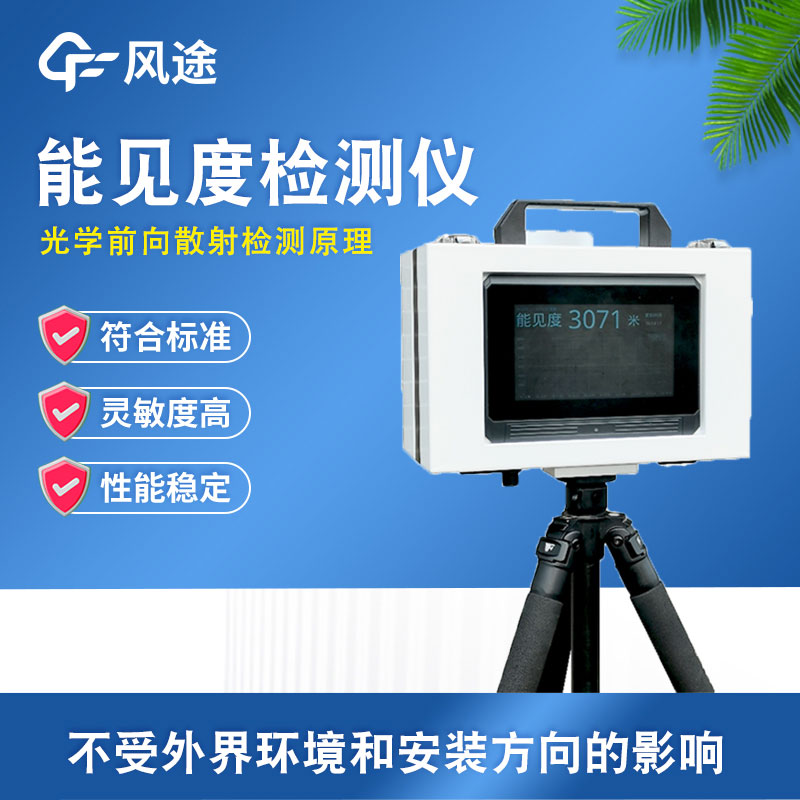
The Portable Visibility Detector is a portable device for measuring visibility in the atmosphere. Its main applications are in transport, energy, chemical and aviation fields and it has a wide range of practical value. The following section describes the solution for the portable visibility detector, including the hardware, software and networking aspects.
Hardware component:
The hardware of the portable visibility detector is mainly composed of optical sensors, optical modules, data collectors and displays.
Optical sensor: The optical sensor detects the light in the atmosphere and measures the visibility based on the degree of light scattering.
Optical module: The optical module is used to collect the signals generated by the optical sensor and provide further signal processing and data analysis.
Data collector: The data collector allows the measured data to be collected and transmitted in real time and includes various communication protocols and interfaces, such as RS485, Modbus, Ethernet, etc.
Display: The display is used to show the measurement results and provide visual data presentation and data analysis.
Software component:
The software of the portable visibility detector mainly includes applications such as data management, data analysis and remote monitoring.
Data management: The data management software can be used to manage and store measurement results and provide functions such as data comparison and trend analysis.
Data analysis: Data analysis software can visualise and process measurement data, provide trend analysis, time series analysis and spectrum analysis.
Remote monitoring: The remote monitoring software allows real-time monitoring and remote control of measurement data from multiple devices through the cloud platform, providing efficient and convenient remote monitoring and management operations.
Network component:
The network component of the portable visibility detector includes both a local area network (LAN) and a cloud platform.
LAN: The data collector and data processor are connected within the same LAN, allowing for data transfer and communication.
Cloud platform: The cloud platform can receive data from different devices and provide functions such as data analysis, trend prediction and report analysis, as well as providing remote monitoring and control functions.
Advantages:
High accuracy: The portable visibility detector allows for high accuracy measurements, which can reach a range of tens to hundreds of metres.
Portable design: the device is compact in design and easy to carry and operate.
Real-time monitoring: enables real-time monitoring and recording for timely data processing.
Remote management: through the cloud platform, remote supervision and management can be provided for convenience.
Summary:
The Portable Visibility Detector is a portable device for measuring visibility in the atmosphere. It allows for high accuracy measurements, real-time monitoring and remote management, and has a wide range of applications. Its solutions include hardware, software and network aspects, and can provide a comprehensive, efficient and reliable solution.
rain gauge wireless for wireless transmission of precipitation, Rain Gauge Wireless is a high-precision, long-range rain gauge that easily and accurately determines rainfall....
In the photovoltaic industry, measuring the power of photovoltaic (PV) modules is crucial for accurately assessing their power generation capacity and performance. This enables manufacturers to ensure product quality compliance, while maintenance personnel can promptly detect changes in module perfo...
Portable surface flow meter is a portable device designed for field open channel flow velocity and flow measurement by departments such as hydrological monitoring, agricultural irrigation, municipal drainage, and environmental protection. It calculates flow rate by directly measuring the surface velocity of water and is suitable for rapid on-site measurement in various scenarios, including natural rivers, channels, and pipeline outlets....
Various methods have long been used to regulate soil moisture to ensure proper crop growth. To know the soil moisture content, apart from relying on experience, a soil moisture monitoring system is now more commonly used. This system measures soil moisture, temperature and other parameters in real t...


 Skype
Skype
 whatsapp
 mail
mail