Shandong Fengtu IOT Technology Co., Ltd
Sales Manager:Ms. Emily Wang
Cel,Whatsapp,Wechat:+86 15898932201
Email:info@fengtutec.com
Add:No. 155 Optoelectronic Industry Accelerator, Gaoxin District, Weifang, Shandong, China


Sales Manager:Ms. Emily Wang
Cel,Whatsapp,Wechat:+86 15898932201
Email:info@fengtutec.com
Add:No. 155 Optoelectronic Industry Accelerator, Gaoxin District, Weifang, Shandong, China
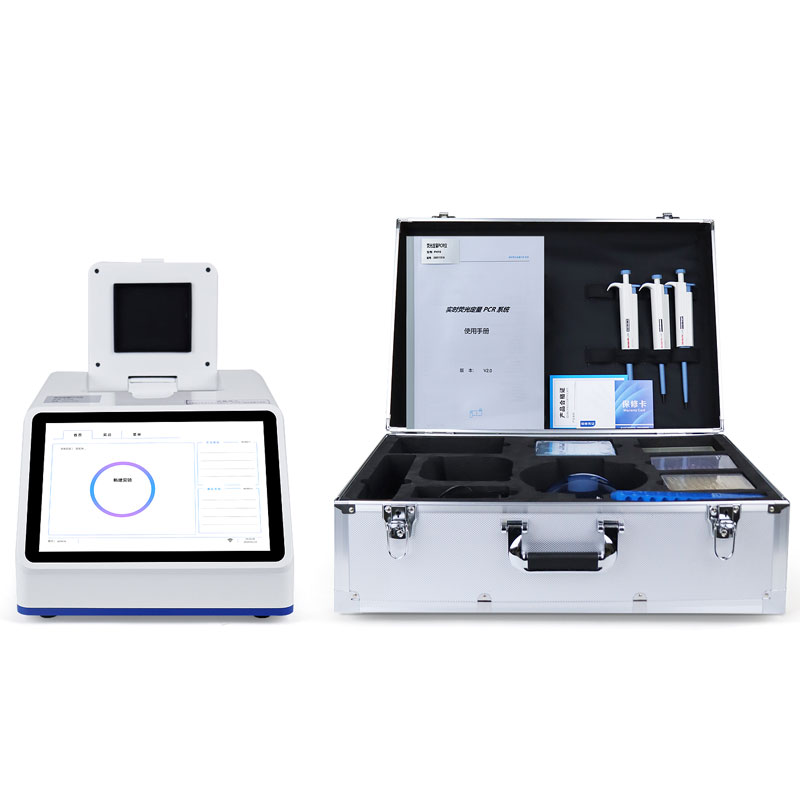
Model:FT-YB416
Brand:fengtu
1、Pet virus detector Product Overview
Pet virus detector adopts nucleic acid free extraction fluorescence quantitative PCR technology, only need to extract pet eye secretions, nasopharyngeal swabs, anal swabs, etc., to complete the virus detection.Based on real-time fluorescence quantitative PCR technology, this product focuses on the accurate detection of pathogen nucleic acids in animal body fluids and tissue samples. Semiconductor temperature control ensures stable amplification, and multi-channel parallel processing supports both qualitative and quantitative analysis. It is suitable for both laboratory and on-site use in farms. With simple operation and automatic report generation, it facilitates early screening and control of diseases, reducing farming risks.
2、Pet virus detector System Components
Pet virus detector consists of a four-channel, 16-well fluorescence quantitative PCR instrument and a portable accessory case.
3、Pet virus detector Application Areas
Basic scientific research, pathogen detection, pet testing, livestock disease detection (cattle, sheep, poultry such as chickens, ducks, and geese, and aquatic animals such as fish and shrimp)
4、Pet virus detector Technical Specifications
1. Features a high-specification aluminum alloy sample holder with excellent thermal conductivity, corrosion resistance, and oxidation resistance, along with Peltier heating and temperature control, and a comprehensive sealing design. Neither sample solution nor condensed water will leak into the Peltier temperature control element or other electronic components below the sample holder, effectively extending the instrument's lifespan.
2. Utilizes a high-precision PT1000 temperature sensor, achieving a temperature control accuracy of 0.01℃, ensuring precise temperature control.
3. Sample throughput: 0.2ml single tube, 0.2ml 8-tube strip.
4. Open reagent and consumable system: Compatible with reagents from any brand, suitable for standard 0.2ml single tubes and 0.2ml 8-tube strips.
5. Employs four high-intensity, broad-spectrum, long-life LED solid-state light sources (blue, green, red, and yellow), ensuring strong light intensity across the entire spectral detection range, improving detection sensitivity. These LEDs are also heat-free, have a long lifespan, and require no maintenance.
6. High-sensitivity detector: Uses a high-sensitivity photomultiplier tube imported from Japan, resulting in higher detection sensitivity.
7. No optical path correction required: The scanning system ensures that the signal excitation and detection optical paths are completely consistent for each well, eliminating the need for optical path correction. This frees up a correction channel, enabling true four-channel gene detection. ★
8. Number of channels: 4 channels.
9. Channel crosstalk: High-precision narrow-band filters are used to greatly reduce channel crosstalk, and the software can also correct crosstalk parameters. 10. Detection Sensitivity: Capable of detecting single-copy DNA templates, and clearly distinguishing between 1000 and 2000 copies of plasmid DNA.
11. Linear Detection Range: 10 orders of magnitude ★
12. Supports common fluorescent dyes and probe detection methods, such as SYBR Green I, Eva Green, Taqman, FRET, Molecular Beacons, Scorpions, Amplifluor, etc.
13. Module Temperature Range: 4-99℃
14. Control Mode: Built-in PCR operating system on the system screen or Windows computer ★
15. Interface: USB connection to computer
16. Operating Noise: Silent technology, maximum operating noise does not exceed 60dB during operation.
17. Operating and Analysis Software
17.1 Allows defining sample wells after running the program, saving experimental time.
17.2 Allows opening other experimental data results for viewing and analysis simultaneously while the program is running.
17.3 The software automatically calculates the baseline range and sets the threshold line, providing users with reliable and accurate data results.
17.4 Experimental program settings and detection results can be directly printed as an experimental report, supporting export in various file formats and data styles such as XLS, CSV, and WORD ★
17.5 Results from the same batch of experiments can be grouped for independent data analysis, with a maximum of 2 groups.
17.6 Provides both Chinese and English software interfaces. ★
17.7 The software can be installed on multiple computers without limitation, requiring no payment for usage rights, and offers free lifetime upgrades. ★
Pet virus detector Instrument technical specifications
| Basic performance | |
| Dimensions | 270*352*195(mm) |
| Weight | 7.1kg |
| Power supply | 220V |
| Power | Maximum working power 300w |
| Operating system | Comes with Android operating system |
| External computer | External Windows computer (Win7 system above) |
| System language | Real-time switch between Chinese and English |
| Communication interface | Square USB |
| Operating environment parameters | |
| Operating ambient temperature | 18~35℃ |
| Operating environment relative humidity | 0%~85% |
| Transport and storage temperature | -20~55℃ |
| Transport and storage relative humidity | 0%~85% |
| System performance | |
| Sample size | 16 holes*0.2ml |
| Sample volume | 15~100ul |
| Applicable consumables | 0.2ml single tube; 8×0.2ml rack tube |
| Temperature control range | 4~99℃ |
| Hot cover temperature | 30℃-108℃(default 105℃, hot plate temperature adjustable) |
| Temperature control method | High-performance imported semiconductors |
| Gradient temperature control | 3-module gradient temperature control, maximum temperature difference support 35℃ |
| Rise rate | 4.5℃/s(MAX) |
| Cooling rate | 3.4℃/s(MAX) |
| Temperature control accuracy | ±0.1℃ |
| Temperature homogeneity | ±0.25℃ |
| Temperature accuracy | ±0.1℃ |
| Functional operation | Pre-set projects and analysis parameters, easy to operate |
| Report | Support report custom modules, 16-hole sub-project printing |
| Analytical function | Multiple qPCR data analysis functions, can detect 4 detection channels at the same time |
| Power-off protection | Can restart interrupted experiments with one key. |
| Instrument information | Have fault records, analysis, prompt functions, more convenient remote problem solving. |
| Analysis algorithm | Amplification curve, standard curve quantitative, melting curve, gene typing (SNP), relative quantification |
| Supporting HRM detection | Support |
| Data Export | The experimental results can be directly exported in the form of graphics and tables; the detailed content of the data report includes experimental conditions, data coordinates and tables, and data analysis parameters. |
| Data format | XLS, CSV, DOCX, PDF |
| TouchDown function | Support time and temperature increase and decrease mode |
| Fluorescence detection system performance | |
| Detection sensitivity | Detectable single copy genes |
| Dynamic range | 1~10^10 |
| Fluorescence repeatability | CV<1% (using a certain brand of reagent for a 16-well uniformity test, the Ct difference between 16 wells is kept within 0.5, and CV is kept within 1%). |
| Correlation coefficient | 0.99~1 (three replicates for each concentration, the correlation coefficient of the standard curve >0.99, the amplification efficiency was maintained between 99%~101%) |
| Amplification efficiency | 99%~101% |
| Credibility | Distinguish 1000 from 2000 copy concentration differences |
| Laser light source | High power LED (maintenance free, long life) |
| Detector | High sensitivity photoelectric sensor |
| Excite and detect the transmission medium | High temperature resistant professional optical fiber |
| Excitation wavelength | 460nm~480nm, 525nm~545nm, 575nm~595nm, 600nm~620nm |
| Detect light wavelength | 505nm~525nm; 555nm~575nm; 600nm~620nm; 660nm~680nm |
The automatic agricultural weather station is capable of automatic sensing, monitoring, warning and analysis of weather, moisture, soil and crop growth, and is so systematic that it achieves intelligent seedling, precision sowing, precision fertilisation, precision irrigation, precision spraying and...
Radar level meters are widely used as liquid level measurement instruments, especially in many storage tanks, where they are used for level measurement. The radar level meter emits an invisible microwave pulse, which is then converted by internal components into a digital signal and displays an accu...
Soil moisture refers to the content of water in the soil, which is crucial for plant growth. The humidity of the soil can be measured by several key indicators:Soil saturation water contentThis refers to the maximum water content that the soil can achieve, where all the pores in the soil are fille...
Highway environmental meteorological monitoring system has been widely used in road construction with its advantages of convenience, speed and accuracy. However, due to the special nature of highway construction conditions, the environmental meteorological observation equipment puts forward high req...


 Get a Free Quote
 Skype
Skype
 whatsapp
 mail
mail