Shandong Fengtu IOT Technology Co., Ltd
Sales Manager:Ms. Emily Wang
Cel,Whatsapp,Wechat:+86 15898932201
Email:info@fengtutec.com
Add:No. 155 Optoelectronic Industry Accelerator, Gaoxin District, Weifang, Shandong, China


Sales Manager:Ms. Emily Wang
Cel,Whatsapp,Wechat:+86 15898932201
Email:info@fengtutec.com
Add:No. 155 Optoelectronic Industry Accelerator, Gaoxin District, Weifang, Shandong, China
time:2025-01-10 10:03:05 source:Weather Station viewed:945 time
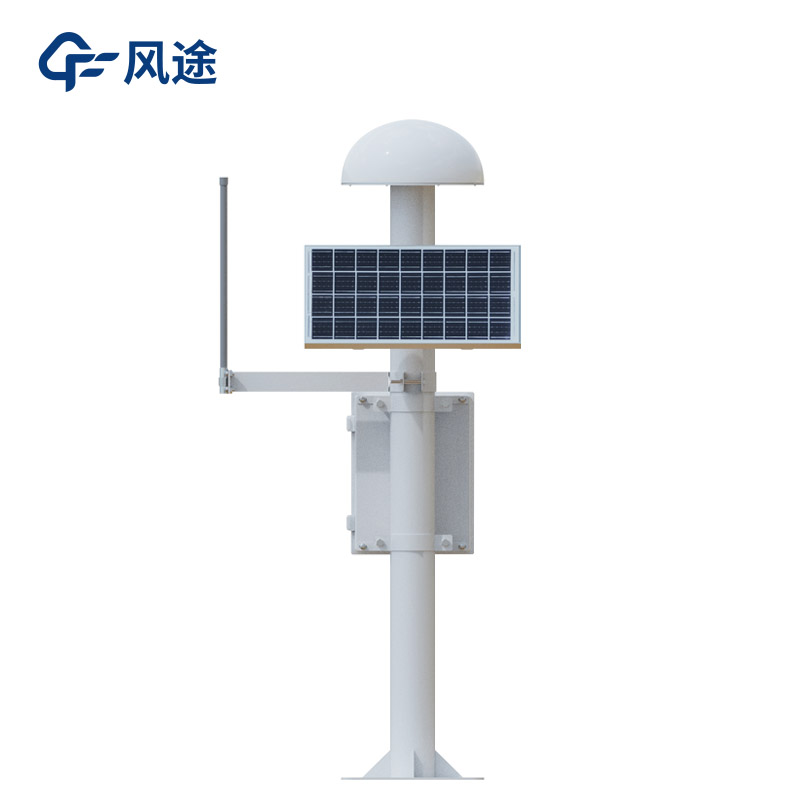
A GNSS monitoring station is a device that achieves high-precision positioning monitoring by using the global navigation satellite system. Its working principle relies on satellite navigation systems such as GPS and Beidou. It receives signals from multiple satellites to determine its own three-dimensional coordinates, continuously locates and measures the displacement of the monitored object, and combines the data of the ground reference station to perform differential processing to improve accuracy.
It consists of multiple parts. The space part has multiple GNSS satellites, which are responsible for transmitting signals to the ground and setting benchmarks. The ground reference station has known precise coordinates and is used to correct the satellite positioning data of the measurement station. The monitoring terminal includes a GNSS antenna, a solar panel, a main control chassis and a mounting bracket, and undertakes the tasks of receiving, collecting and uploading data.
The positioning accuracy can reach millimeter to sub-meter level. It can collect and transmit data in real time, allowing staff to timely master the situation of the monitored object. It can operate automatically, saving manpower. It is compatible with multiple satellite navigation systems and the data is reliable. With stable software and hardware, it can adapt to harsh environments and operate stably for a long time.
It is widely used in geological disaster monitoring to keep an eye on potential hazards such as landslides and mudslides; in engineering deformation monitoring to safeguard infrastructure such as bridges and dams; in earthquake monitoring to assist in the study of crustal movement; and in geodetic surveying to lay a solid data foundation for research in multiple fields.
Windway introduces the 10-in-1 Micro Weather Meter, a solution to the challenges of environmental monitoring. This device is capable of comprehensively monitoring key environmental indicators such as temperature, humidity, barometric pressure, wind speed, wind direction, illuminance, rainfall, noise...
Water transparency sensor employs the scattered light detection principle, combining an infrared LED light source with signal isolation technology to enhance anti-interference capabilities. It supports RS485 communication, is IP68 waterproof, and is easy to install. It can perform long-term on...
Remote Rain Gauge is an IoT-based intelligent rainfall monitoring device. Utilizing piezoelectric sensing and AI recognition technology, it achieves high-precision monitoring, supports wireless remote data transmission and platform-based visual management, and is suitable for all-weather rainf...
instruments of weather and their uses Instruments of weather and their uses There are many instruments that collect weather data, usually the following: thermometers, barometers, hygrometers, anemometers, total radiometers, etc....


 Skype
Skype
 whatsapp
 mail
mail