Shandong Fengtu IOT Technology Co., Ltd
Sales Manager:Ms. Emily Wang
Cel,Whatsapp,Wechat:+86 15898932201
Email:info@fengtutec.com
Add:No. 155 Optoelectronic Industry Accelerator, Gaoxin District, Weifang, Shandong, China


Sales Manager:Ms. Emily Wang
Cel,Whatsapp,Wechat:+86 15898932201
Email:info@fengtutec.com
Add:No. 155 Optoelectronic Industry Accelerator, Gaoxin District, Weifang, Shandong, China
time:2024-05-30 08:37:44 source:Weather Station viewed:988 time
Agricultural sensors are a very critical technology in smart agriculture. This technology was patented and researched from 1917 until 2006, when 47 related patents were filed globally.After 2006, with the rapid development of information agriculture, there was a significant advancement in agricultural sensor technology, and the investment model shifted from government support to commercial investment, which attracted many experienced investors. Since then, the number of global patent applications for agricultural sensors has surged to 9,372.
Sensors play a crucial role in the transition to smart modern agriculture: they not only monitor all aspects of the agricultural environment, but also collect critical data information. Now, let's explore 5 common sensor devices in smart agriculture!
1, Temperature Sensors
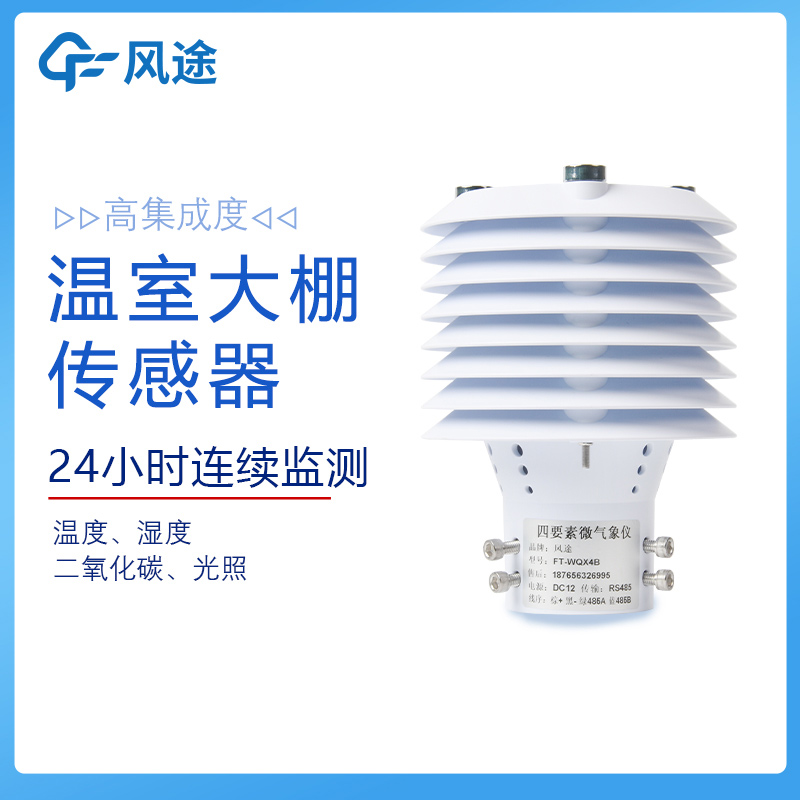
Temperature is one of the key environmental factors that affect crop growth. Temperature sensors play an important role in smart agriculture as they monitor the temperature changes in the surrounding environment in real time. When the temperature is detected to deviate from the ideal range for crop growth, the sensors will sound an alarm to remind managers to take appropriate measures, such as adjusting the temperature control equipment to maintain the appropriate temperature required for crop growth.
2, Moisture Sensor
Moisture is vital to plant growth, and moisture sensors can help us better manage the moisture needs of crops. In sheds that require a humid environment, sensors can monitor humidity and maintain it through irrigation systems.
3, Carbon Dioxide Sensor
Plants use carbon dioxide to make organic matter through photosynthesis, so more carbon dioxide can help plants grow better. In greenhouses, carbon dioxide sensors can tell us how much carbon dioxide is in the air.
4, PH Sensor
Plants need the right soil pH to grow, and different fertilisers have an effect on soil pH. By monitoring soil pH, managers can estimate the amount of nutrients in the soil. Combined with the use of sensors that measure total phosphorus, total nitrogen, and total potassium in the soil, soil fertility can be more accurately controlled, thus promoting crop growth more effectively.
5, Light Sensor
Light is critical to crop growth in agricultural development. Light sensor is very sensitive to light changes, lightweight design, easy to install, good waterproof function.
These are the 5 common sensors in smart farmland, the data from these sensors can be integrated into the smart agriculture management system, through data analysis and artificial intelligence algorithms, to provide decision-making support for farmers, to optimise crop planting and management strategies, to improve crop yield and quality, and at the same time to reduce resource waste and production costs.
Greenhouses play a vital role in agricultural production, providing indispensable support for the cultivation of high-value vegetables, anti-seasonal crops and rare fruits, making their position in the modern agricultural field more and more prominent.Greenhouse greenhouse has many advantages, it is...
A rain gauge is a device used to measure the amount of rainfall, also known as a rain gauge or rain observer. It is able to collect and record the amount of rainfall that falls in a certain area during a certain period of time by certain technical means and output the corresponding data. Rain gauges...
Ultrasonic wind speed sensor principle:It uses ultrasonic time difference method to realize wind speed and wind direction measurement. As the speed of sound propagation in the air, it will be and wind direction. Above the airflow speed iteration. If the ultrasonic propagation direction and the wind...
An ultrasonic level gauge is an instrument that uses ultrasonic sensing technology to measure liquid levels. It consists of an ultrasonic transducer (probe), a driving circuit (module), an electronic liquid crystal display module, and other components. Its working principle is as follows: The transd...


 Skype
Skype
 whatsapp
 mail
mail