Shandong Fengtu IOT Technology Co., Ltd
Sales Manager:Ms. Emily Wang
Cel,Whatsapp,Wechat:+86 15898932201
Email:info@fengtutec.com
Add:No. 155 Optoelectronic Industry Accelerator, Gaoxin District, Weifang, Shandong, China


Sales Manager:Ms. Emily Wang
Cel,Whatsapp,Wechat:+86 15898932201
Email:info@fengtutec.com
Add:No. 155 Optoelectronic Industry Accelerator, Gaoxin District, Weifang, Shandong, China
time:2024-06-18 08:37:08 source:Weather Station viewed:993 time
Soil is the bedrock of crop growth, providing water, nutrients, and other key resources. Five major factors - matrices, climate, biology, topography and time - shape the characteristics of soil. A soil census is a comprehensive examination of the condition of soils, which is essential for ensuring food security and implementing land management strategies. This census focuses on arable land, garden land, forest land and grassland, helping us to understand the current status of soils and providing a scientific basis for improving land-use efficiency and securing food production.
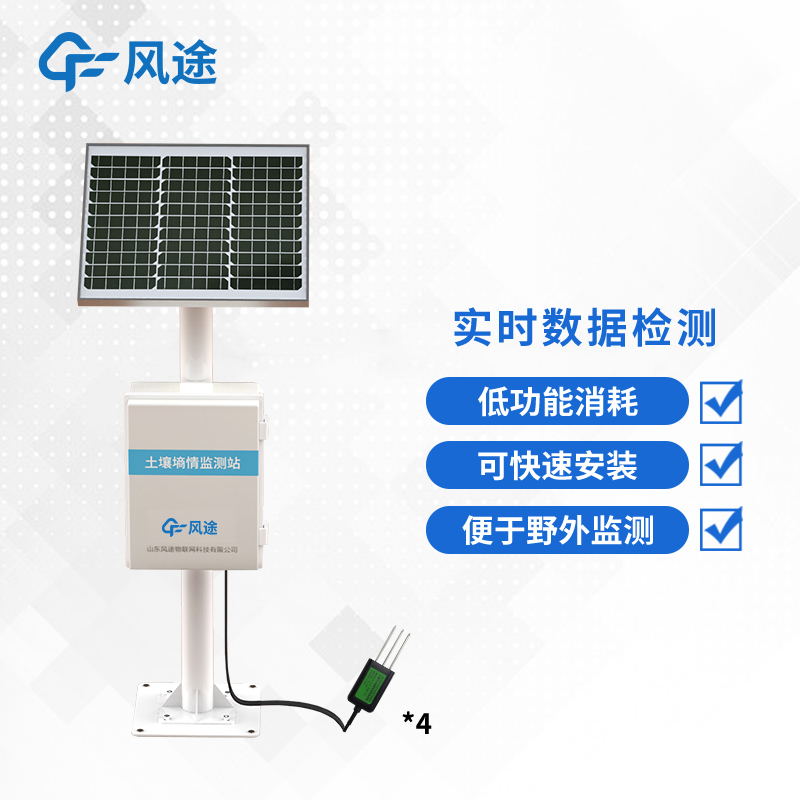
Long-term mechanised farming may lead to tightening of the soil, thinning of the tillage layer and even soil crusting, which will undoubtedly have a negative impact on soil structure. In order to effectively monitor and improve soil conditions, the automatic soil moisture monitoring station plays an important role.
It is capable of on-site testing of soil moisture, temperature, salinity and other key indicators around the clock. Its advantage lies in its ability to collect soil moisture data automatically without supervision and transmit the data to the monitoring centre in real time through wired or wireless means, such as GPRS and Bluetooth. In this way, we can monitor the soil status 24 hours a day and analyse the dynamic changes of soil moisture in depth through the generated reports.
The soil moisture monitoring station is equipped with moisture and temperature sensors which are capable of measuring the volumetric moisture content and temperature of the soil in real time. By connecting with professional data collectors and software platforms, the monitoring data can be effectively stored and processed to provide a scientific basis for agricultural decision-making.
Monitoring soil temperature, moisture and water level helps farmers to irrigate more rationally, saving water and preventing the loss of soil nutrients through over-irrigation. The monitoring station can also detect nitrogen, phosphorus and potassium in the soil, as well as dissolved oxygen and pH, helping farmers to understand the soil nutrient status, guiding them to apply fertilisers more accurately to improve crop yields and reduce environmental pollution.
Grid monitoring has achieved remarkable results in controlling air pollution. It can accurately locate pollution sources. By constructing a dense monitoring network in different areas, such as dividing ordinary grids in cities, setting encrypted grids in key areas, and arranging irregular grids in s...
Telemetry terminal is an industrial-grade communication terminal that integrates data acquisition, wireless transmission, and device control functions. It is designed for hydrological monitoring, flood control and early warning, and water resource management. Through real-time data acquisition, processing, and remote transmission, it supports remote telemetry and monitoring applications in various industries, including water conservancy, meteorology, and agriculture....
Video telemetry terminal is a microprocessor-controlled industrial intelligent gateway designed for hydrological, meteorological, and geological monitoring scenarios. It facilitates data acquisition and storage, multi-protocol communication, and remote control. Its low-power design supports solar po...
Moisture monitoring is the process of monitoring soil moisture in real time. This can be achieved by means of fixed automatic soil moisture monitoring stations (soil moisture monitors). This type of monitoring station can monitor soil moisture automatically, continuously and in real time, providing...



 Skype
Skype
 whatsapp
 mail
mail