Shandong Fengtu IOT Technology Co., Ltd
Sales Manager:Ms. Emily Wang
Cel,Whatsapp,Wechat:+86 15898932201
Email:info@fengtutec.com
Add:No. 155 Optoelectronic Industry Accelerator, Gaoxin District, Weifang, Shandong, China


Sales Manager:Ms. Emily Wang
Cel,Whatsapp,Wechat:+86 15898932201
Email:info@fengtutec.com
Add:No. 155 Optoelectronic Industry Accelerator, Gaoxin District, Weifang, Shandong, China
time:2026-02-04 09:54:36 source:Weather Station viewed:475 time
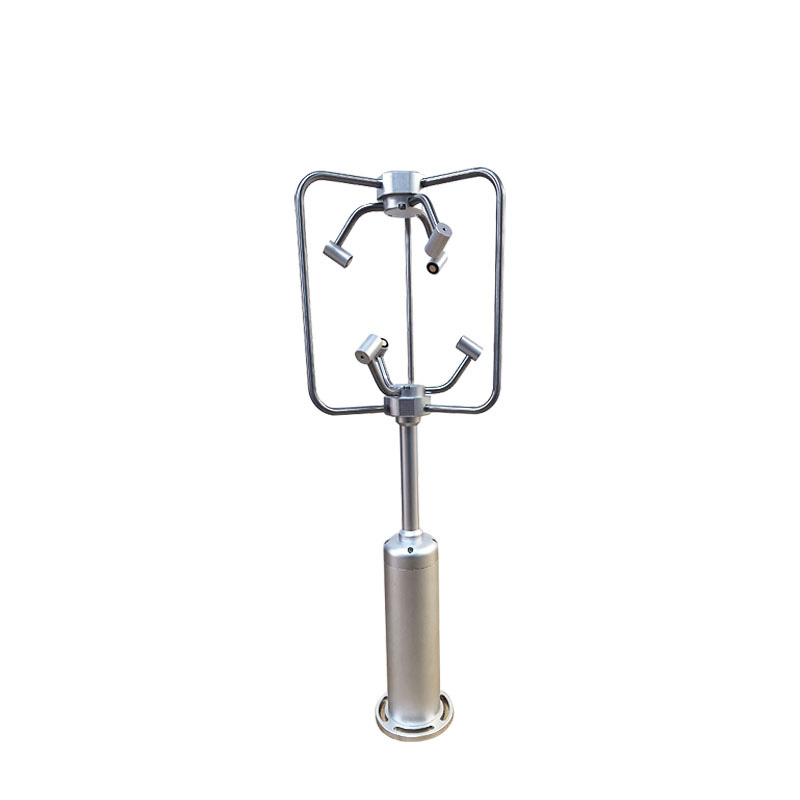
3D Ultrasonic Anemometer utilizes the ultrasonic phase difference principle to measure wind speed and direction. Using multiple pairs of ultrasonic probes, it simultaneously measures the wind speed components along the mutually perpendicular X, Y, and Z axes in three-dimensional space (i.e., the U, V, and W vectors), and calculates the resultant wind speed and real-time wind direction.
The core working principle of 3D Ultrasonic Anemometer is based on the physical characteristic that the speed of sound propagation in air is affected by wind speed. The instrument is typically equipped with three or more pairs of high-precision ultrasonic transducers that transmit and receive ultrasonic pulses at specific angles (such as orthogonal angles) within a fixed, small measurement space. By precisely measuring the time difference of ultrasonic propagation along the upwind and downwind paths, the instrument can calculate the wind speed component along each sound path in real time. Subsequently, the built-in processor uses vector synthesis algorithms to calculate the instantaneous three-dimensional wind speed vector (U, V, W), as well as the two-dimensional horizontal wind direction, wind speed, and vertical wind speed.
The device offers comprehensive core measurement parameters. It directly outputs instantaneous wind speed values along the X, Y, and Z axes, fully reflecting the three-dimensional structure of the wind field. Based on this vector data, it can accurately calculate the horizontal wind speed magnitude, horizontal wind direction angle (0-360°), and vertical wind speed. This feature allows it to monitor subtle vertical airflow and complex turbulent motion, which is impossible with traditional mechanical or two-dimensional ultrasonic anemometers. Its measurement typically has no starting wind speed threshold, allowing for continuous measurement from near-zero speeds to high wind speeds of tens of meters per second.
Due to the absence of mechanical moving parts, 3D Ultrasonic Anemometer offers advantages in reliability. It overcomes the drawbacks of mechanical anemometers and wind vanes, such as wear and tear, inertial lag, the need for regular calibration, and potential failure in freezing weather. The all-solid-state design ensures long-term stable operation in various harsh environments, significantly reducing maintenance requirements. Its high-frequency response characteristics (sampling frequency typically reaching tens of Hertz or more) allow it to accurately capture instantaneous wind fluctuations, which is a critical requirement in turbulent flux research and wind engineering.
Currently, this instrument has been integrated into various professional monitoring systems. In the field of professional meteorological observation, it provides high-precision wind field profile data. In highway and bridge weather stations, it is used to monitor crosswinds and strong winds that threaten driving safety. In the field of wind power generation, it is used for wind turbine wake studies, wind resource assessment, and wind turbine power curve validation. On offshore platforms and research vessels, it facilitates air-sea interaction and boundary layer research. Furthermore, it is a core sensor in eddy covariance flux observation systems, used for directly measuring carbon dioxide, water vapor, and heat fluxes between the land and atmosphere.
With its accurate, reliable, and high-frequency three-dimensional wind field measurement capabilities, 3D Ultrasonic Anemometer provides an indispensable high-quality data foundation for multiple critical fields such as meteorological research, environmental monitoring, industrial safety, and new energy development, supporting refined analysis, safety warnings, and scientific decision-making.
best weather stations for home can be used to monitor air temperature, humidity, atmospheric pressure, wind speed, wind direction....
Fengtu is a meteorological station manufacturer located in Shandong. It has also launched its own independently developed air quality sensor. There are mainly the following types:Multi-element meteorological sensorThe ft-wqx5 five-element micro meteorological instrument can accurately monitor wind s...
weather instruments can be used to measure the weather, allowing you to monitor wind speed, direction, temperature, pressure, humidity and many other meteorological elements....
The Multi Depth Soil Moisture Probe is a piece of intelligent equipment. This equipment is of great significance. On the one hand, it can meet the needs of production entities to conduct real-time monitoring of soil factors for crop growth. On the other hand, it can also meet the requirements for lo...


 Skype
Skype
 whatsapp
 mail
mail