Shandong Fengtu IOT Technology Co., Ltd
Sales Manager:Ms. Emily Wang
Cel,Whatsapp,Wechat:+86 15898932201
Email:info@fengtutec.com
Add:No. 155 Optoelectronic Industry Accelerator, Gaoxin District, Weifang, Shandong, China


Sales Manager:Ms. Emily Wang
Cel,Whatsapp,Wechat:+86 15898932201
Email:info@fengtutec.com
Add:No. 155 Optoelectronic Industry Accelerator, Gaoxin District, Weifang, Shandong, China
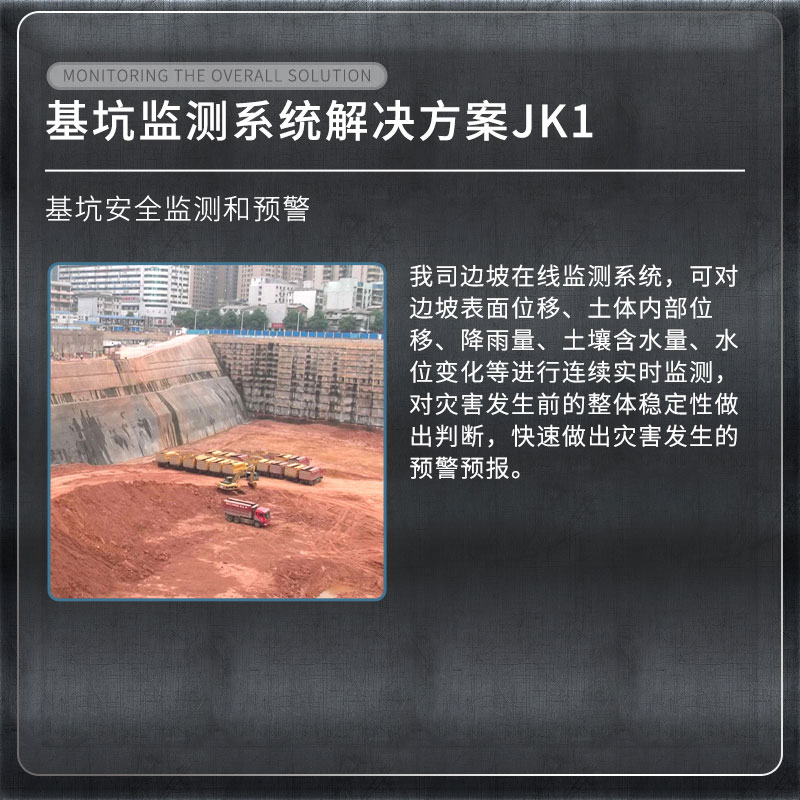
Model:FT-JK1
Brand:fengtu
1.Foundation pit monitoring background
Foundation pit monitoring is determined according to the design depth of foundation pit, geological conditions, surrounding environment and supporting structure type.Urban foundation pit excavation has the characteristics of high construction risk and great construction difficulty. At present, the excavation of foundation pits in Shenzhen, Guangzhou, Dongguan and other places is getting deeper and deeper, from the initial four to eight meters to the current deepest of more than 20 meters. Due to the complexity of underground soil properties, load conditions, and construction environment, the design and construction plan determined solely based on geological survey data and indoor geotechnical test parameters often contains many uncertain factors. Monitoring of changes in soil properties, environment, adjacent buildings, and underground facilities caused during the construction process has become an indispensable and important part of engineering construction. It is also the eyes to guide correct construction, a necessary measure to avoid accidents, and an information technology. At present, foundation pit monitoring is listed as one of the three basic elements of deep foundation pit engineering quality assurance along with engineering design and construction.
2. Foundation pit monitoring system overview
As a pioneer in China's structural safety monitoring industry, our company has taken the lead in combining structural health monitoring with IoT structural systems, cloud computing, LAN/communication networks and other multi-network seamless connection technologies to establish an intelligent foundation pit online monitoring system to conduct real-time monitoring of foundation pit construction sites. The monitoring system based on the cloud computing service center can accommodate monitoring data of tens of thousands of bridges, tunnels, slopes and other structures, forming a regional structural health monitoring platform to achieve unified monitoring and management of all structures in the region.
3. Main monitoring contents of Foundation pit monitoring
1. Construction foundation pit: settlement and horizontal displacement of the top of retaining piles (walls), deep horizontal displacement of retaining piles (walls), internal force of retaining piles (walls), deep horizontal displacement of soil outside the pit, axial force of anchor rods, groundwater level, axial force of support, and uplift of pit bottom
2. Surrounding risk sources: surface settlement, pipeline settlement, building tilt, uneven building settlement, building cracks, bridge pier tilt, uneven bridge pier settlement
4. Foundation pit monitoring project list
| Monitoring items | Device Name |
| Support shaft force | Strain gauges, force gauges |
| Anchor bolt axial force | Steel bar meter |
| Groundwater level | Pore water pressure gauge |
| Vertical displacement of column structure | Fully automatic robot |
| Support piles (walls), vertical and horizontal displacements of slope top | Fully automatic robot |
| Horizontal displacement of supporting piles (walls) | Tandem fixed inclinometer |
| Surface subsidence | Static level, fully automatic robot |
| Vertical displacement of underground pipelines | Fully automatic robot |
| Vertical displacement of buildings (structures) | Static Level |
| Building (structure) cracks | Crack Meter |
| Vertical displacement of bridge piers | Fully automatic robot |
| Bridge pier tilt | Box type fixed inclinometer |
| Bridge cracks | Crack Meter |
5. Foundation pit monitoring basis
"Technical Specifications for Construction Monitoring of Urban Rail Transit Projects DG/TJ 08-2224-2017"
"Technical Specifications for Urban Rail Transit Engineering Monitoring GB50911-2013"
"Technical Specifications for Construction Foundation Pit Engineering Monitoring GB50497-2009"
"Technical Standard for Monitoring Construction Pit Engineering GB 50497-2019"
6. Foundation pit monitoring implementation functions
1. 24-hour real-time monitoring: Through real-time online monitoring of support structures, surface settlement, retaining pile inclination, etc., the structural changes of the construction foundation pit can be grasped in real time.
2. Report push: The monitoring results are displayed and published in real time, and monitoring reports are pushed to users regularly.
3. Multiple-level warning: Establish a three-level alarm mechanism. When the detection data is abnormal, the user will be notified by SMS, fax, broadcast, etc. at the first time to realize the comprehensive warning function.
4. Emergency plan processing: directly extract the corresponding processing methods from the expert system, and take measures such as personnel intervention and road blocking in time to eliminate safety hazards in the bud.
5. Structural trend analysis: Structural stability trend analysis can be achieved through monitoring data analysis and safety evaluation during foundation pit construction.
6. Historical data storage: The storage of monitoring data provides an analogy basis for the design and construction of similar projects in the future.
A wind sensor is a sensor device used to measure and record the direction of the wind, usually in the fields of meteorology, environmental monitoring and agriculture. It calculates the wind direction by measuring the wind speed and, based on the principles of hydrodynamics. These sensors usually pro...
rain gauge definition is an instrument used by meteorologists and hydrologists to measure the amount of precipitation in an area over a period of time....
Diffuse visibility meters are key devices that, through the use of advanced technology and principles, can accurately measure visibility and help improve safety and operational efficiency in a variety of industries. In this article, we will introduce the working principle, advantages and application...
Mining operations are like a double-edged sword: while fueling economic growth, they leave behind environmental challenges, with slope instability and soil erosion being the most pressing. Mountain landslides are no trivial matter—accidents such as equipment burial and worker entrapment occur frequ...


 Get a Free Quote
 Skype
Skype
 whatsapp
 mail
mail