Shandong Fengtu IOT Technology Co., Ltd
Sales Manager:Ms. Emily Wang
Cel,Whatsapp,Wechat:+86 15898932201
Email:info@fengtutec.com
Add:No. 155 Optoelectronic Industry Accelerator, Gaoxin District, Weifang, Shandong, China


Sales Manager:Ms. Emily Wang
Cel,Whatsapp,Wechat:+86 15898932201
Email:info@fengtutec.com
Add:No. 155 Optoelectronic Industry Accelerator, Gaoxin District, Weifang, Shandong, China
time:2026-06-03 10:56:40 source:Weather Station viewed:265 time
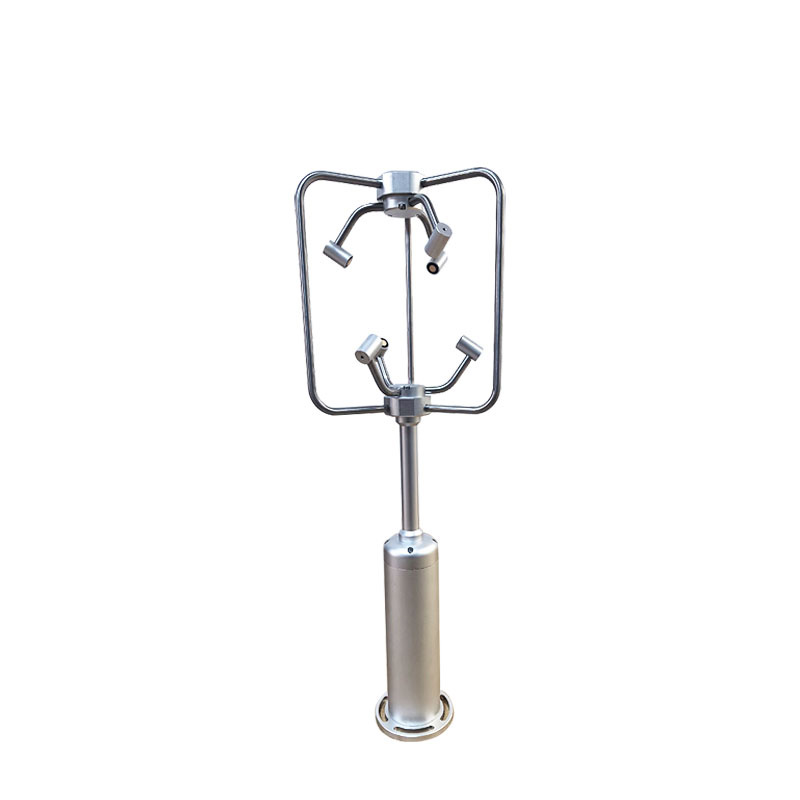
The 3D ultrasonic anemometer uses ultrasonic time-of-flight measurement technology. It incorporates six transducers to achieve omnidirectional acquisition of three-dimensional wind speed vectors (U/V/W) and wind direction. Containing no rotating parts, it eliminates mechanical wear and startup wind speed limitations, offering fast response and high measurement accuracy. It is suitable for high-precision wind field monitoring needs in various fields such as meteorological monitoring, wind power generation, aviation safety, and bridge and tunnel engineering.
The 3D ultrasonic anemometer is one of the fastest-growing technologies in the field of wind field monitoring in recent years. Compared to traditional mechanical anemometers that rely on the rotation of wind cups and vanes to measure wind, the 3D ultrasonic anemometer has no moving parts, fundamentally eliminating inherent defects such as mechanical wear, rotational inertia, and startup wind speed limitations. It measures the effect of wind on the speed of sound propagation using the ultrasonic time-of-flight method. Six or more ultrasonic transducers are installed on the sensor probe, polling and receiving ultrasonic pulses. By measuring the time difference of ultrasonic wave propagation in the downwind and upwind directions, the wind speed and wind direction angle can be calculated. This principle allows it to start at zero wind speed, capturing high-frequency pulsations and turbulent components that are difficult to detect with traditional mechanical sensors.
In terms of technical parameters, ultrasonic anemometers from different manufacturers and models cover a wide measurement range. Some products have a wind speed measurement limit of 85 m/s, a wind direction measurement range of 0 to 360°, and a resolution of 0.01 m/s and 0.1°, fully meeting the needs from routine meteorological observation to extreme weather monitoring. Built-in temperature sensors can correct for changes in sound speed with ambient temperature in real time, ensuring the accuracy of measurement data. Data output frequencies are typically 20 Hz to 32 Hz, with some high-end models reaching even higher frequencies to meet the high-frequency sampling requirements of turbulence research and flux observation. Communication interfaces widely support protocols such as RS485 and Modbus RTU/TCP, facilitating integration into various meteorological or industrial monitoring systems. Protection ratings generally reach IP67 or higher, with some models offering IP69K protection and built-in heating modules to withstand harsh environments such as extreme cold, icing, salt spray, and sandstorms.
In terms of applications, 3D ultrasonic anemometers have a wide range of applications. In meteorological monitoring, they can be deployed at weather stations, weather towers, or UAV platforms for studying complex wind field structures such as boundary layer turbulence and low-level jets, providing high-resolution observational data for numerical weather prediction models. In the wind power industry, the equipment is installed on anemometer towers or wind turbine hubs to monitor turbulence intensity, wind shear, and yaw error in real time, helping to optimize turbine power curves and load control strategies, thereby improving power generation efficiency. In aviation safety, these sensors are deployed on airport runways to monitor low-level wind shear and micro-downbursts, providing early warning support for flight takeoffs and landings. Furthermore, 3D ultrasonic anemometers also play an important role in scenarios such as wind load monitoring in bridges and tunnels, wind-assisted navigation for maritime vessels, and pollutant diffusion path analysis by environmental protection departments.
The advantages of 3D ultrasonic anemometers are not only reflected in their performance parameters but also in their reliability and maintenance costs. Because there are no rotating parts, the equipment requires almost no replacement of worn parts throughout its life cycle, greatly reducing maintenance workload. Some models feature an all-metal body and aerospace-grade aluminum alloy, providing corrosion and impact resistance, and adaptability to various outdoor deployment environments. The modular design and push-pull connectors also facilitate easier on-site installation and replacement. Thanks to these combined advantages, 3D ultrasonic anemometers are gradually replacing traditional cup anemometers, becoming a core tool for meteorological monitoring, wind energy assessment, and industrial environmental measurement.
China is a large agricultural country, and agriculture occupies an important position in the national economy. In order to guarantee the continuous supply and quality and safety of agricultural products, we need to use agricultural high technology to promote the modernisation of agriculture. Precisi...
It employs a fluorescence detection principle, leveraging the absorption and emission peaks of soluble oil spectra for accurate detection. Supporting RS485 communication output, it boasts high anti-interference capabilities and stability, making it suitable for various industries' online w...
Soil moisture monitoring is crucial for preventing drought and promoting green and sustainable development of agriculture, and it is also the basis for realising water-saving agriculture and building a modern agricultural system.By strengthening the monitoring of soil moisture and drought conditions...
Water monitoring system, mainly used in hydrological forecasting to achieve automatic measurement and analysis of water level, flow and water quantity. It collects and transmits data information through various sensors, converts them into digital signals and then processes them to get the correspond...


 Skype
Skype
 whatsapp
 mail
mail