Shandong Fengtu IOT Technology Co., Ltd
Sales Manager:Ms. Emily Wang
Cel,Whatsapp,Wechat:+86 15898932201
Email:info@fengtutec.com
Add:No. 155 Optoelectronic Industry Accelerator, Gaoxin District, Weifang, Shandong, China


Sales Manager:Ms. Emily Wang
Cel,Whatsapp,Wechat:+86 15898932201
Email:info@fengtutec.com
Add:No. 155 Optoelectronic Industry Accelerator, Gaoxin District, Weifang, Shandong, China
time:2026-06-16 13:20:56 source:Weather Station viewed:90 time
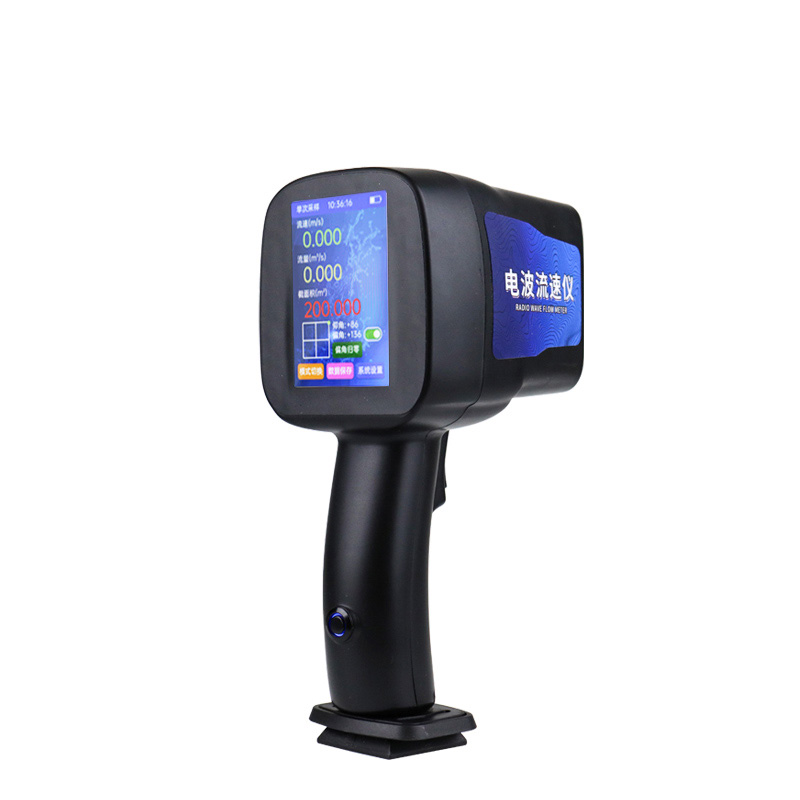
Radio current meters utilize K-band radar technology, based on the Doppler effect, to achieve non-contact flow velocity measurement of rivers, sewage, mud, and oceans. The device is compact, handheld, battery-powered, unaffected by sewage corrosion and silt interference, and can safely perform measurements within a 100-meter range.
A radio current meter is a non-contact water flow velocity measurement device based on the Doppler effect principle of radar. The instrument transmits 24GHz K-band radio waves, receives the reflected echoes from the water surface, and calculates the Doppler frequency shift to obtain the surface flow velocity data. The instrument generally consists of three parts: a sensor, a signal processor, and a power supply. The sensor includes a microwave generator, processing unit, transmitting and receiving unit, and antenna.
In terms of structural design, radio current meters are compact and lightweight, with most models weighing less than 1 kg, allowing for handheld operation by a single person or mounting on a tripod. The device is powered by lithium-ion or nickel-metal hydride batteries, allowing for 8 to 15 hours of continuous operation on a single charge. The instrument housing is primarily made of ABS resin, offering impact resistance, corrosion resistance, and electrical insulation; some models achieve an IP67 waterproof rating. The user interface features a Chinese-language guided menu, and a built-in angle sensor automatically corrects horizontal and vertical angles, enabling one-button operation for flow velocity correction measurements.
The core advantage of the radio wave current meter lies in its non-contact measurement. Traditional submersible flow velocity meters are susceptible to corrosion and interference in sewage, high-sediment-content, or debris-rich waters, while the radar probe of the radio wave current meter does not contact the water, fundamentally avoiding these problems. Within an effective measurement range of 100 meters, operators can complete the work from the shore, on a bridge, or on a boat without entering dangerous waters. The instrument's velocity measurement range is typically 0.03 to 30 meters per second, with a measurement accuracy of ±0.03 meters per second.
In terms of applications, the radio wave current meter is widely used in water conservancy and hydrological monitoring, environmental wastewater monitoring, and marine current velocity measurement. This instrument is particularly suitable for field surveys and emergency measurement tasks such as floods, dam breaks, breaches, and debris flows, playing an irreplaceable role in peak flood measurement during the flood season. When the water flow is rapid, with high sediment content and abundant floating debris, conventional flow measuring instruments are difficult to operate, and even the buoy method is not feasible. The radio wave current meter, with its non-contact and rapid response characteristics, can reliably acquire flow velocity data. The instrument supports multiple modes, including single and continuous measurements, and can store hundreds to thousands of records. Some models are also equipped with wireless flow velocity measurement software and a cloud data management platform, facilitating subsequent data analysis and flow estimation.
With its non-contact, high-precision, portable, and safe performance characteristics, the radio wave current meter has become an important tool in the fields of hydrological monitoring and emergency measurement.
The selection of Ultrasonic Wind Speed Direction Sensor should take various factors into comprehensive consideration.Firstly, measurement accuracy is crucial. In scenarios such as meteorological monitoring and scientific research where high data accuracy is required, a high-precision sensor is indis...
In the operation and maintenance of expressways, slope disaster monitoring has always been a key aspect. Traditional monitoring methods, limited by high equipment costs, often focus only on key slopes, leaving many potential disaster-prone locations outside the monitoring scope. The sudden nature of...
water quality detector uses chemical, physical or biological reactions to measure conductivity, dissolved oxygen, pH, COD and other parameters, suitable for monitoring natural water, surface water or groundwater quality....
Agricultural mini-weather stations are an important technical tool in agricultural production activities and one of the manifestations of smart agriculture. In the process of China's agricultural development, agricultural weather information has always played an extremely important role, which n...


 Skype
Skype
 whatsapp
 mail
mail