Shandong Fengtu IOT Technology Co., Ltd
Sales Manager:Ms. Emily Wang
Cel,Whatsapp,Wechat:+86 15898932201
Email:info@fengtutec.com
Add:No. 155 Optoelectronic Industry Accelerator, Gaoxin District, Weifang, Shandong, China


Sales Manager:Ms. Emily Wang
Cel,Whatsapp,Wechat:+86 15898932201
Email:info@fengtutec.com
Add:No. 155 Optoelectronic Industry Accelerator, Gaoxin District, Weifang, Shandong, China
time:2026-07-17 09:04:26 source:Weather Station viewed:45 time
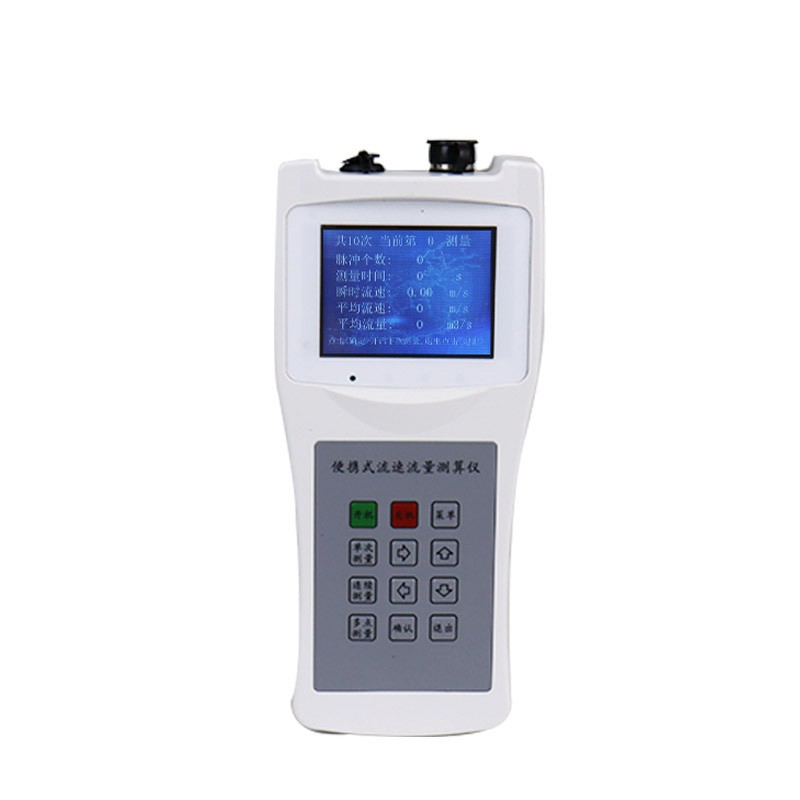
Handheld Flow Meter is a professional instrument developed for field measurements of flow velocity and discharge in open channels, serving sectors such as hydrological stations, industrial and mining enterprises, environmental monitoring stations, agricultural irrigation and drainage, and hydrogeological surveys. The equipment package includes a flow velocity sensor, signal connector, flow velocity meter, charging adapter, and data cable; the sensor's propeller has been redesigned to ensure precise and reliable measurements.
Handheld Flow Meter is specialized equipment designed for field open-channel flow velocity and discharge measurements by hydrological stations, industrial and mining enterprises, environmental monitoring stations, agricultural irrigation and drainage departments, and hydrogeological survey teams. The instrument operates in conjunction with a flow velocity sensor; the sensor features a redesigned propeller—optimizing the helix angle, pitch, manufacturing process, and materials—to meet measurement requirements across diverse hydrological conditions.
Regarding its composition, the standard configuration of the Handheld Flow Meter comprises five components: a flow velocity sensor, signal connector, flow velocity meter, charging adapter, and data cable. The flow velocity meter features a built-in 6000mAh battery, a 5V 2.5A charger, a Type-C interface, a 2.8-inch TFT screen, and 6MB of MSC data storage capacity, with an operating temperature range of 0°C to 50°C. The flow velocity sensor has a starting velocity of 0.03 m/s, a measurement range of 0.01 to 4.00 m/s (extendable to 5.00 m/s), a supply voltage of 3.3V, a measurement error of no more than 1.5%, and a maximum measurement depth of 410mm.
In terms of measurement principles, the instrument generates rotation signals via an internal signaling device driven by hydraulic force. Based on the total number of signals generated within a specific time interval, the flow velocity is automatically calculated using the formula v = a + bR/T (m/s). Here, v represents the average flow velocity during the measurement period, b is the hydraulic pitch of the propeller, a is the instrument constant, T is the duration of the measurement, and R is the total number of rotor revolutions during time interval T. For any specific flow meter unit, the parameters *b* and *a* are constants; consequently, calculating the flow velocity requires only the acquisition of *T* and *R* values. Regarding flow rate measurement, the user selects the cross-section type and manually inputs parameters—such as water level and width for regular cross-sections—to determine the cross-sectional area; the instrument then calculates the flow rate using the formula Q=VS.
The Handheld Flow Meter is designed to balance portability with functionality; its compact size and light weight make it suitable for field use and one-handed operation. Its applications span diverse fields, including hydrological surveys, municipal engineering, agricultural irrigation, ecological research, and emergency response. The instrument supports three operating modes—continuous, single, and triggered measurement—features adjustable data storage intervals, and incorporates a temperature compensation algorithm to correct for the impact of water temperature on measurement accuracy. For hydrologists and environmental monitoring personnel requiring frequent open-channel flow velocity and rate monitoring in the field, the Handheld Flow Meter offers a highly integrated and user-friendly measurement solution.
What is the difference between ultrasonic level meter and radar level meter? Many people are puzzled by this, today I will explain the difference between the two.Ultrasonic level meter mainly through ultrasonic waves to determine the height of the liquid medium position, and radar level meter throug...
Corrosion-resistant radar level gauge is a kind of instrument used to measure the height of liquid level in liquid container. It uses radar technology to send and receive microwave signals to measure the liquid level height by measuring the propagation time of the microwave signals or the echo stren...
Field microclimate refers to a small local area, which is the most important environmental condition affecting crop growth and development and yield formation. By analyzing the distribution and characteristics of microclimate elements in farmland through field microclimate observation stations, we c...
Water: Essential, but Water Quality Matters MoreWater is vital, yet water quality is even more critical. To protect water resources, we need to measure water quality, focusing on indicators such as temperature, transparency, hardness, pollutant content, and pH. These data directly reflect the health...


 Skype
Skype
 whatsapp
 mail
mail