Shandong Fengtu IOT Technology Co., Ltd
Sales Manager:Ms. Emily Wang
Cel,Whatsapp,Wechat:+86 15898932201
Email:info@fengtutec.com
Add:No. 155 Optoelectronic Industry Accelerator, Gaoxin District, Weifang, Shandong, China


Sales Manager:Ms. Emily Wang
Cel,Whatsapp,Wechat:+86 15898932201
Email:info@fengtutec.com
Add:No. 155 Optoelectronic Industry Accelerator, Gaoxin District, Weifang, Shandong, China
time:2024-12-17 09:45:38 source:Weather Station viewed:684 time
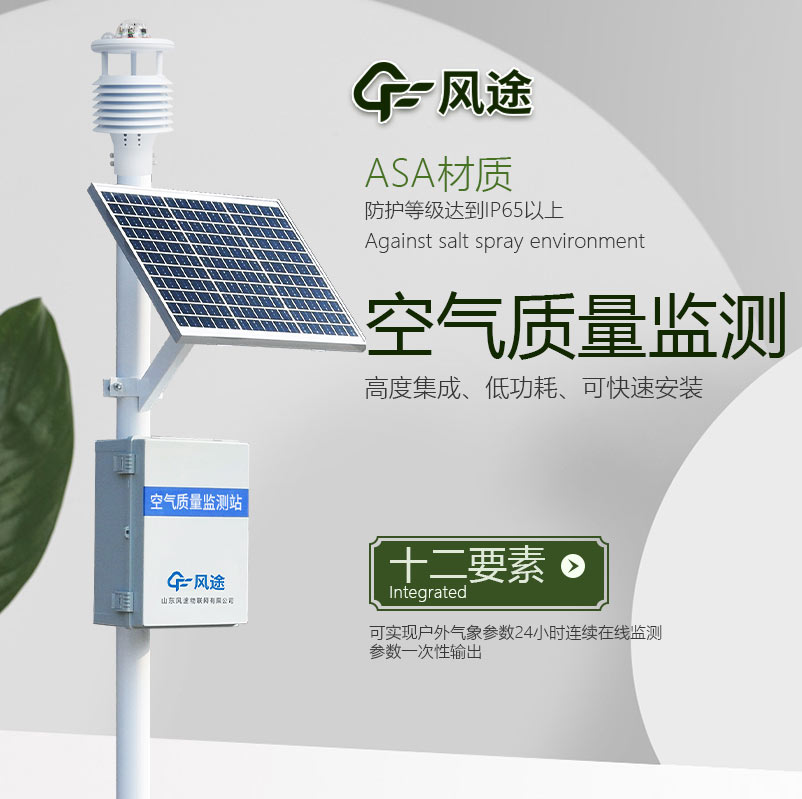
The Air Quality Monitoring Station plays a crucial role in environmental supervision.
The Air Quality Monitoring Station can monitor the concentrations of various pollutants and meteorological parameters in the air, such as PM2.5, PM10, SO₂, NO₂, CO, O₃, TVOC, etc., in real-time and continuously, providing detailed and accurate data for environmental supervision departments. This enables them to grasp the environmental situation promptly and offers a scientific basis for decision-making. By rationally setting up monitoring points in key areas such as industrial parks, transportation hubs, and construction sites, the pollution sources can be accurately located, helping the supervision departments to take targeted measures and improve supervision efficiency. Moreover, the system transmits data in real-time. Once abnormal situations such as excessive pollutants occur, the supervision departments can respond quickly and handle them in a timely manner to reduce the impact of pollution. It helps to construct a grid-based supervision system, subdividing the monitoring area to achieve comprehensive coverage and refined management, and promotes public participation and improves the transparency of environmental information.
Environmental supervision also drives the development of the Air Quality Monitoring Station. The improvement of supervision requirements prompts the continuous optimization and upgrading of the system to meet the higher requirements for the accuracy, timeliness, and comprehensiveness of air quality monitoring data, enabling it to play a greater role in pollution source analysis, pollution trend prediction, and environmental risk warning. The standards and specifications formulated by the supervision departments ensure the construction, operation, and data quality of the system and expand its application fields, such as for volatile organic compounds, ozone monitoring, and environmental monitoring in rural and remote areas. The supervision needs promote the sharing and integration of monitoring system data with other environmental data to form a unified big data platform, providing in-depth analysis support for comprehensive decision-making.
The Air Quality Monitoring Station and environmental supervision promote each other, jointly contribute to improving air quality and strengthening environmental protection, and drive the continuous progress of environmental governance.
Radar Flow Meters is a non-contact flow measurement device utilizing a K-band planar microstrip array antenna, suitable for flow measurement in rivers, canals, natural streams, and reservoir dams. It can be used in various professional fields such as hydrological surveys, agricultural irrigation, and municipal drainage....
The automatic monitoring station of ambient air quality can conduct real-time online monitoring of pollution factors in the air, and can provide data feedback through a large screen or display data through the user data statistics port. The monitoring items include the four gases and two dusts inclu...
The principle of the meteorological environment monitor is to obtain various physical parameters in the atmosphere (including temperature, humidity and wind) by sensor detection, and then analyze and calculate the external conditions based on the obtained data for monitoring purposes. It works by au...
The portable flow velocity meter is a device developed for fieldwork in hydrological stations, factories, mines, environmental monitoring stations, farmland irrigation and drainage, and hydrogeological surveys to measure the flow velocity and flow rate of open channels. It features a starting...



 Skype
Skype
 whatsapp
 mail
mail