Shandong Fengtu IOT Technology Co., Ltd
Sales Manager:Ms. Emily Wang
Cel,Whatsapp,Wechat:+86 15898932201
Email:info@fengtutec.com
Add:No. 155 Optoelectronic Industry Accelerator, Gaoxin District, Weifang, Shandong, China


Sales Manager:Ms. Emily Wang
Cel,Whatsapp,Wechat:+86 15898932201
Email:info@fengtutec.com
Add:No. 155 Optoelectronic Industry Accelerator, Gaoxin District, Weifang, Shandong, China
time:2025-07-02 09:08:23 source:Weather Station viewed:608 time
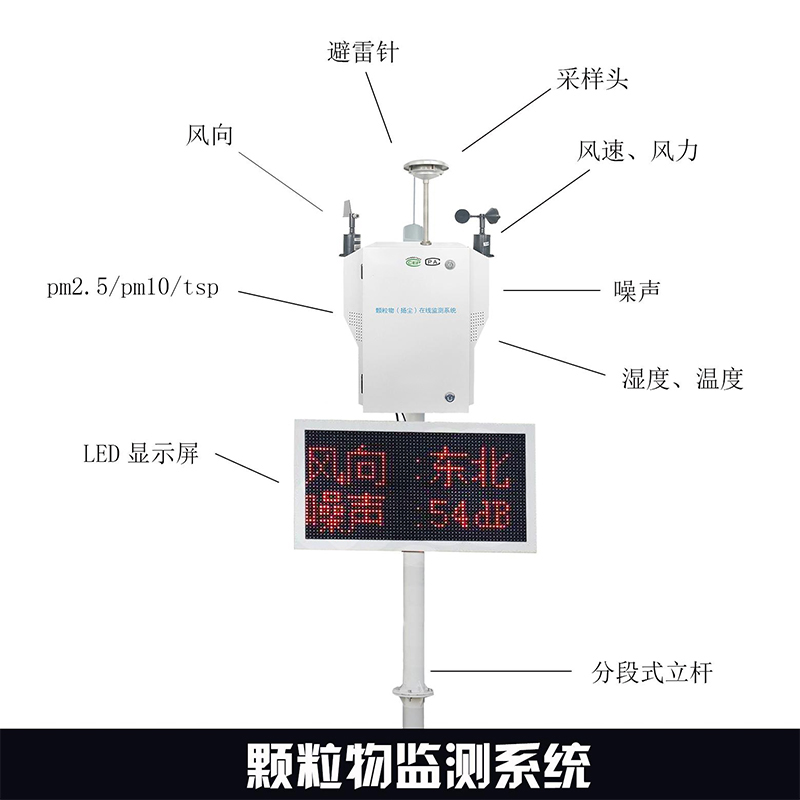
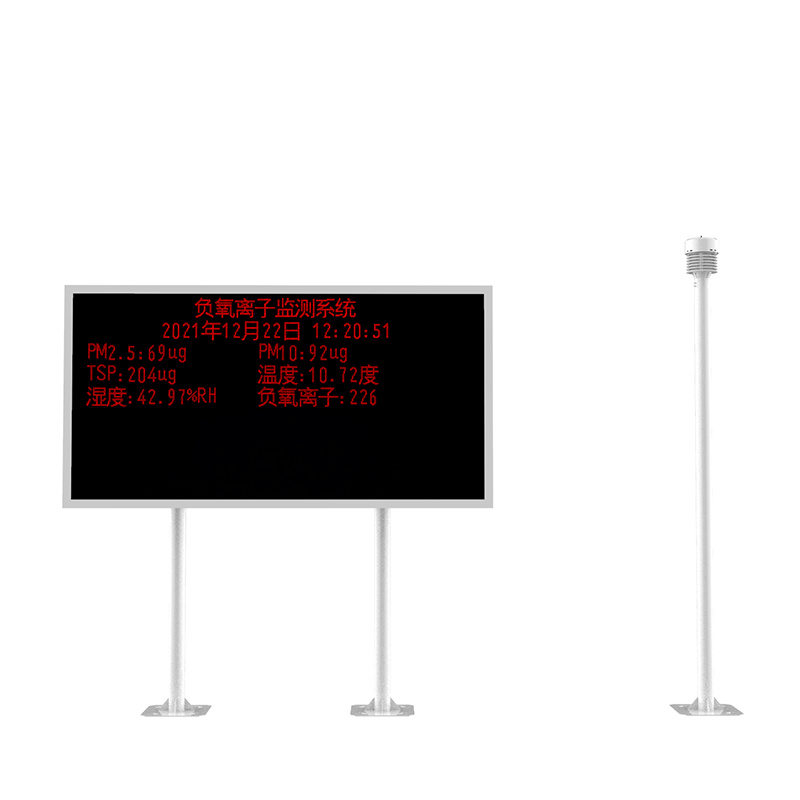
Particulate matter is a key factor affecting air quality, and precise monitoring contributes to environmental protection. Particulate Monitors, especially those with PM2.5/PM10/TSP three-channel output functions, are becoming common tools in the field of environmental monitoring.
Such monitoring equipment adopts the principle of laser scattering, which accurately measures the concentration of particulate matter with different particle sizes in the air by emitting laser beams and detecting the intensity of scattered light from particulate matter. The three channels of PM2.5, PM10, and TSP can operate simultaneously and independently. The PM2.5 channel captures fine particulate matter with a particle size ≤2.5 microns, which can penetrate deep into the human lungs and harm health; the PM10 channel monitors inhalable particulate matter with a particle size ≤10 microns; the TSP channel covers all solid and liquid total suspended particulate matter in the air. The simultaneous output of the three channels can synchronously obtain comprehensive and detailed particulate matter data, providing rich basis for environmental analysis.
Each channel focuses on measurement within a specific particle size range to avoid mutual interference of particulate matter with different particle sizes, controlling the measurement error within an extremely small range and significantly improving monitoring accuracy. The equipment can continuously monitor in real time, outputting the latest concentration data every few minutes to promptly reflect the dynamic changes in air quality.
Construction sites use it to real-time monitor construction dust. Once the concentration of PM10, PM2.5, or TSP exceeds the standard, an alarm is immediately triggered, and the construction party can timely take dust reduction measures such as increasing sprinkling and enabling fog cannons to reduce the impact on the surrounding environment. Municipal departments evaluate the effectiveness of dust suppression measures such as road cleaning and sprinkling by monitoring the concentration of PM10 and TSP in urban road dust, so as to optimize the sanitation operation plan. In industrial plants such as steel, cement, and chemical industries, the equipment can monitor particulate matter emissions during the production process, helping enterprises reduce energy consumption and emissions, and providing reliable data for environmental protection departments' supervision.
Reservoir automatic monitoring system is a new monitoring technology developed on the basis of traditional reservoir monitoring equipment. It realizes real-time data transmission and processing through computer or communication network. Advanced computer technology is used to establish a database an...
A miniature weather station is a compact weather sensor device that is often used to measure and record data on weather parameters such as temperature, humidity, air pressure, wind speed and wind direction. Compared to traditional large weather stations, mini weather stations are small, light, easy...
Soil moisture monitoring techniques fall into three main categories: direct measurements, matrix potential measurements and non-contact indirect measurements.Direct measurements: moisture content is calculated by weighing and drying soil samples, or measured directly using instruments such as neutro...
Depth Sounder is an electronic instrument that measures water depth using the principle of sound wave propagation in water. This device calculates the time interval between the transmission and reception of ultrasonic waves reflected from the seabed, and automatically converts this time interval into a water depth value based on the known speed of sound. Its core component is an underwater transducer, and it features portability and adjustable accuracy. It is widely used in professional fields such as hydrological surveys of rivers, lakes, and oceans, navigation, and underwater engineering measurements....


 Skype
Skype
 whatsapp
 mail
mail