Shandong Fengtu IOT Technology Co., Ltd
Sales Manager:Ms. Emily Wang
Cel,Whatsapp,Wechat:+86 15898932201
Email:info@fengtutec.com
Add:No. 155 Optoelectronic Industry Accelerator, Gaoxin District, Weifang, Shandong, China


Sales Manager:Ms. Emily Wang
Cel,Whatsapp,Wechat:+86 15898932201
Email:info@fengtutec.com
Add:No. 155 Optoelectronic Industry Accelerator, Gaoxin District, Weifang, Shandong, China
time:2025-08-05 09:14:42 source:Weather Station viewed:783 time
Currently, the development of ice sensing technology is quite mature, with dozens of detection principles and methods available. According to differences in principles, ice sensors can be categorized into optical, electrical, mechanical, thermal, waveguide, and other types. Among them, the electrical method is further subdivided into capacitive, conductive, and other methods; the mechanical method is divided into differential pressure, resonance, obstacle, and other methods; the optical method is subdivided into optical fiber, infrared blocking, infrared reflection, infrared imaging, and other methods. In recent years, infrared ice sensors have achieved rapid development and application due to their advantages such as non-contact, easy maintenance, and strong anti-interference ability.
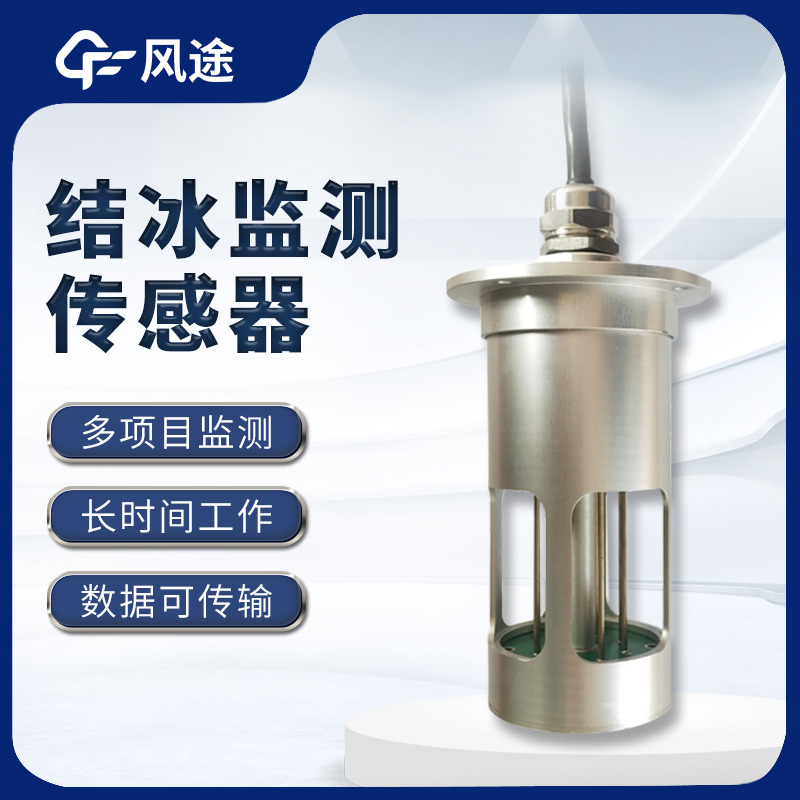
The FT-JB1H ice sensor is a device that can convert ice signals into directly detectable electrical signals to monitor the ice thickness on the surface of objects. Its main application scenario is power line towers.
The sensor has characteristics such as rapid response, high sensitivity, convenient installation, and small size, which make its installation and use on power line towers more convenient. On power line towers, it can monitor the ice formation on the surface of cables in real-time. Once the cables are iced over, it may cause excessive load on the cables, and even lead to serious accidents such as cable breakage and tower collapse, affecting the safe and stable transmission of electricity.
China has a vast territory and diverse climatic conditions. Power line towers in many regions are vulnerable to ice damage in winter or under specific climates. The application of the FT-JB1H ice sensor on power line towers can timely provide ice warning information for power departments, facilitating staff to take de-icing and other response measures, and ensuring the normal operation of the power system.
At present, the ultrasonic wind speed and direction meter has become a relatively advanced wind speed and direction measuring instrument. Because it can better overcome the inherent shortcomings of the mechanical wind speed and direction meter, so that it can be all-weather long time normal operatio...
The 3D ultrasonic anemometer uses ultrasonic time-of-flight measurement technology. It incorporates six transducers to achieve omnidirectional acquisition of three-dimensional wind speed vectors (U/V/W) and wind direction. Containing no rotating parts, it eliminates mechanical wear and startup...
Automated agricultural weather stations are playing an increasingly important role in agricultural weather disaster prevention and mitigation. Because the appropriate climatic conditions required for different crops to grow in different environmental conditions vary significantly, an automatic weath...
Oil dielectric constant sensor utilizes electrochemical impedance spectroscopy (EIS) to detect the dielectric constant of lubricating oil in real time. It exhibits high sensitivity to oil contamination, additive depletion, and aging, allowing for online measurement of oil quality changes and p...


 Skype
 whatsapp
 mail