Shandong Fengtu IOT Technology Co., Ltd
Sales Manager:Ms. Emily Wang
Cel,Whatsapp,Wechat:+86 15898932201
Email:info@fengtutec.com
Add:No. 155 Optoelectronic Industry Accelerator, Gaoxin District, Weifang, Shandong, China


Sales Manager:Ms. Emily Wang
Cel,Whatsapp,Wechat:+86 15898932201
Email:info@fengtutec.com
Add:No. 155 Optoelectronic Industry Accelerator, Gaoxin District, Weifang, Shandong, China
time:2026-06-01 09:24:32 source:Weather Station viewed:165 time
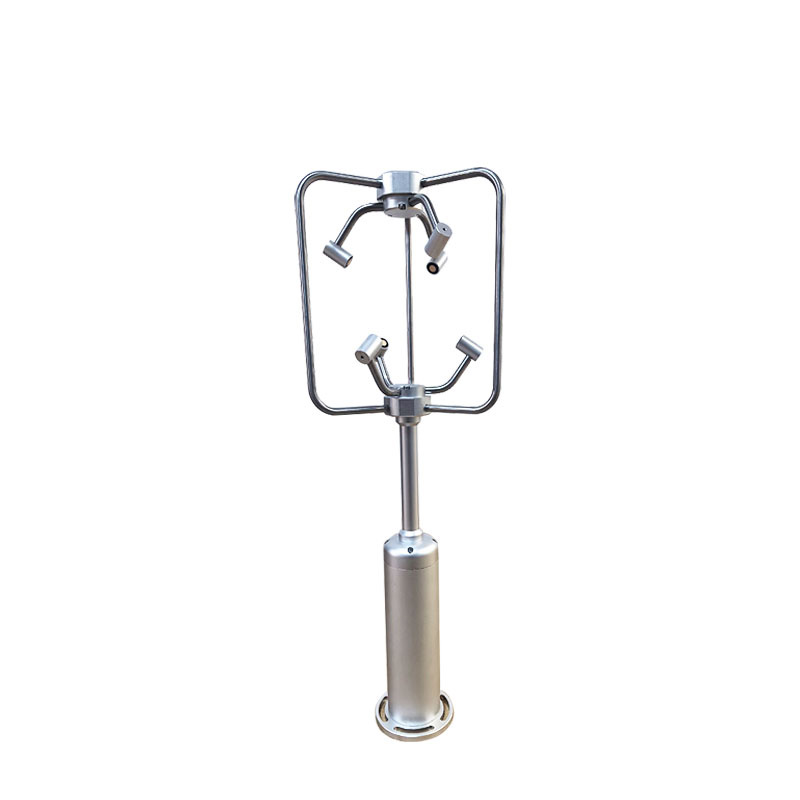
3D anemometer employs ultrasonic measurement technology, featuring an all-metal body with no moving parts. It can simultaneously output wind speed data along the X, Y, and Z axes, making it suitable for meteorological monitoring, wind power generation, bridge and tunnel applications, and airports.
3D anemometer is a professional meteorological monitoring instrument based on ultrasonic measurement technology. Unlike traditional mechanical anemometers, the 3D anemometer has no rotating parts. Its all-metal design provides greater durability and corrosion resistance, enabling all-weather operation in various harsh environments. Its core working principle is the ultrasonic time-of-flight method: multiple pairs of built-in ultrasonic transducers transmit and receive signals. When ultrasonic waves propagate through the air, wind speed affects their propagation speed; propagation is faster with the wind and slower against the wind. By measuring the time difference of ultrasonic wave propagation in different directions, the wind speed and direction in three-dimensional space can be accurately calculated.
A three-dimensional anemometer can simultaneously measure and output wind speed components in three directions: X, Y, and Z, i.e., U, V, and W vector outputs, thus enabling comprehensive monitoring of horizontal wind speed, vertical wind speed, and wind direction. The measurement frequency of a three-dimensional anemometer typically ranges from 20Hz to 100Hz, with some research-grade products achieving sampling frequencies exceeding 100Hz. This allows it to capture wind speed and turbulence changes over minute timescales, meeting the stringent requirements of flux observation and eddy covariance studies. In terms of technical parameters, mainstream three-dimensional anemometers generally have a wind speed measurement range of 0 to 60 m/s or 0 to 70 m/s, a resolution of up to 0.01 m/s, and a wind direction measurement accuracy typically within ±2°.
Due to its all-metal construction and component-free structure, a three-dimensional anemometer offers significant advantages such as high measurement accuracy, fast response speed, long service life, and low maintenance costs. Its all-metal casing and high protection rating (typically IP65 or higher) enable it to withstand harsh environments such as rain, snow, sandstorms, and salt spray. Some models also offer an optional heating module to effectively eliminate the impact of rain, snow, and ice on measurements. Furthermore, the 3D anemometer features zero-start wind speed capability, allowing it to operate from zero wind speed without any physical rotation, avoiding the low-wind-speed measurement errors caused by frictional wear in traditional mechanical anemometers. For data output, the instrument is typically equipped with multiple communication interfaces such as RS232, RS485, SDI-12, and USB, supporting the ModBus-RTU protocol for seamless integration with various data acquisition systems and meteorological monitoring platforms.
The 3D anemometer has been widely used in numerous fields, including professional meteorological observation, road weather stations, wind power research, marine wind power research, flux systems, urban environmental monitoring, bridge and tunnel ventilation monitoring, and maritime and airport applications. In the field of wind power generation, three-dimensional anemometers can be used for wind resource assessment, wind turbine site selection, and wind power prediction; in bridge and tunnel monitoring, they can monitor crosswinds and wind speed changes in real time, providing early warnings for traffic safety; in environmental monitoring, three-dimensional anemometers are an important data source for air diffusion research and pollutant transport analysis. With their high precision, high reliability, and strong environmental adaptability, three-dimensional anemometers have become one of the key pieces of equipment in modern meteorological monitoring systems.
What is a ducted air speed sensor?Firstly, let's understand why ducts need to measure wind speed. In many industrial and construction applications, ducts are commonly used to transport gases or liquids such as oil, gas, water, air and other chemicals. In these applications, the wind speed inside...
The negative oxygen ion monitoring system is a monitoring station that automatically collects air cleanliness index data in tourist scenic spots and ecological parks (such as artificial wetlands, ecological scenic spots, botanical gardens, etc.). ).Monitor the negative oxygen ions, temperature, humidity, PM2.5 and other environmental quality parameters in scenic spots....
The automatic rainfall monitoring station monitors and analyzes the precipitation of the city in real time, providing an important reference basis for urban planning. It is an important part of rainfall monitoring, which can obtain the precipitation distribution status in the rainfall process in rea...
Most of the new energy research and development work is actually carried out in a relatively open environment, especially for wind and solar energy research and development, often due to the installation of the environment is very open caused by some important devices are easily affected by changes...



 Skype
Skype
 whatsapp
 mail
mail