Shandong Fengtu IOT Technology Co., Ltd
Sales Manager:Ms. Emily Wang
Cel,Whatsapp,Wechat:+86 15898932201
Email:info@fengtutec.com
Add:No. 155 Optoelectronic Industry Accelerator, Gaoxin District, Weifang, Shandong, China


Sales Manager:Ms. Emily Wang
Cel,Whatsapp,Wechat:+86 15898932201
Email:info@fengtutec.com
Add:No. 155 Optoelectronic Industry Accelerator, Gaoxin District, Weifang, Shandong, China
time:2026-05-27 09:42:00 source:Weather Station viewed:151 time
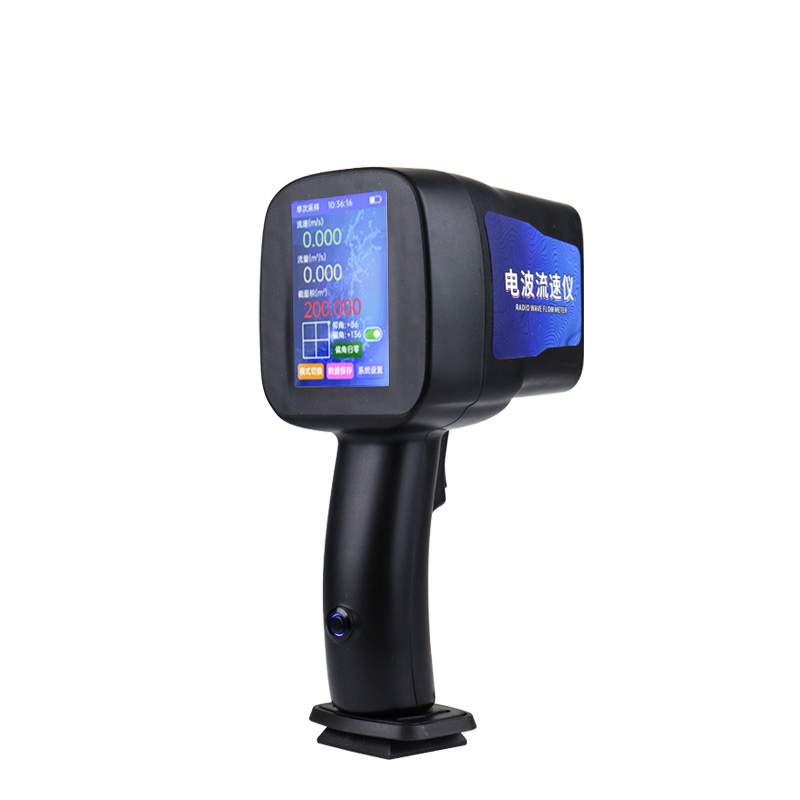
Handheld radar current meters use K-band radar to measure the flow velocity of rivers, sewage, mud, and oceans without contact. They are unaffected by sewage corrosion and sediment interference, with a maximum measurement distance of 100 meters, ensuring operator safety and making them suitable for flood control and emergency monitoring.
The working principle of a handheld radar current meter is based on the radar Doppler effect. The instrument emits K-band radio waves at 24 GHz or 35.5 GHz. These waves are reflected upon contact with the flowing water surface, and a difference exists between the frequency of the reflected wave and the emitted wave. Due to variations in water surface velocity, this frequency difference changes, and the instrument's built-in signal processor calculates the surface velocity of the water body based on this difference. This principle makes the measurement completely independent of water transparency and water quality conditions; even in rivers with extremely high sediment content, the instrument can still obtain a stable signal. The radio wave transmission angle is typically 12° or 24°×12°, with a transmission power between 10mW and 18dBm, ensuring reliable signal return strength within a 100-meter range. A built-in tilt sensor automatically performs cosine compensation for the vertical angle; when the operator aims at the water surface from different angles, the readings are automatically corrected, eliminating the need for manual calculation.
Structurally, the handheld radar current meter is designed with durability and portability in mind for field use. The housing is made of ABS resin with an aluminum alloy frame, providing impact resistance, high and low temperature resistance, corrosion resistance, and electrical insulation. The protection rating generally reaches IP67, allowing normal operation within a temperature range of -30℃ to +70℃, protecting the safety of the measurement personnel even during thunderstorms. The overall weight is controlled between 700 grams and 1.3 kilograms, supporting single-person handheld measurement, and a tripod can be optionally installed for fixed-point observation. The power supply system uses a built-in rechargeable lithium battery or nickel-metal hydride battery, with a battery life ranging from 8 to 25 hours. Some models support USB charging, allowing for convenient replenishment via power banks or vehicle power supplies outdoors. The large-capacity data storage function typically saves 2,000 to 10,000 measurement records, and the USB interface supports one-click data export to a USB flash drive for quick on-site export and archiving.
The application scenarios for handheld radar current meters are mainly concentrated in situations where conventional flow measuring instruments are difficult to operate. In rivers with rapid currents, high sediment content, and abundant floating debris, traditional rotor-type current meters are prone to clogging or damage, and buoy deployment methods are also difficult. Handheld radar current meters, however, can be used to perform measurements directly on the bank or on a bridge. In flood control and emergency response scenarios, this device can quickly measure peak flow velocities, providing crucial data support for downstream early warning and flood control scheduling. In wastewater discharge monitoring and mud flow velocity monitoring, non-contact measurement avoids the problem of instruments being damaged by highly corrosive liquids. In addition, this equipment is also suitable for monitoring water flow velocity during railway bridge construction, field hydrological surveys, and emergency flow measurement after dam breaches. Equipped with wireless flow velocity measurement software and a cloud-based hydrological flow velocity big data management platform, it can aggregate and analyze measurement results from multiple handheld devices, enabling remote data viewing and unified management.
Depth finder is a portable ultrasonic depth sounder that uses ultrasonic measurement to determine water depth in real time. The instrument has a range of 0 to 50 meters, a blind zone of 0.5 meters, and can operate stably in still water and currents up to 5 meters per second. It is small and li...
Photovoltaic environmental monitor is a device used to monitor the environmental parameters of photovoltaic panel modules and their surroundings, which is commonly used in solar power stations, rooftop photovoltaic power generation and household photovoltaic power generation systems. The device is c...
The price of a wind speed sensor is greatly affected by the product type and functional configuration. The FT series offers various models with prices ranging from 600 to 18,000 yuan. Users can choose the appropriate equipment based on their monitoring scenario and output signal requirements....
Soil moisture, which refers to the humidity state of the soil, is crucial for plant growth. In agricultural planting, farmers often mention terms like "seizing moisture," "conserving moisture," and "losing moisture." These practices are all aimed at maintaining suitable...


 Skype
Skype
 whatsapp
 mail
mail