Shandong Fengtu IOT Technology Co., Ltd
Sales Manager:Ms. Emily Wang
Cel,Whatsapp,Wechat:+86 15898932201
Email:info@fengtutec.com
Add:No. 155 Optoelectronic Industry Accelerator, Gaoxin District, Weifang, Shandong, China


Sales Manager:Ms. Emily Wang
Cel,Whatsapp,Wechat:+86 15898932201
Email:info@fengtutec.com
Add:No. 155 Optoelectronic Industry Accelerator, Gaoxin District, Weifang, Shandong, China
time:2024-06-26 08:41:15 source:Weather Station viewed:1013 time
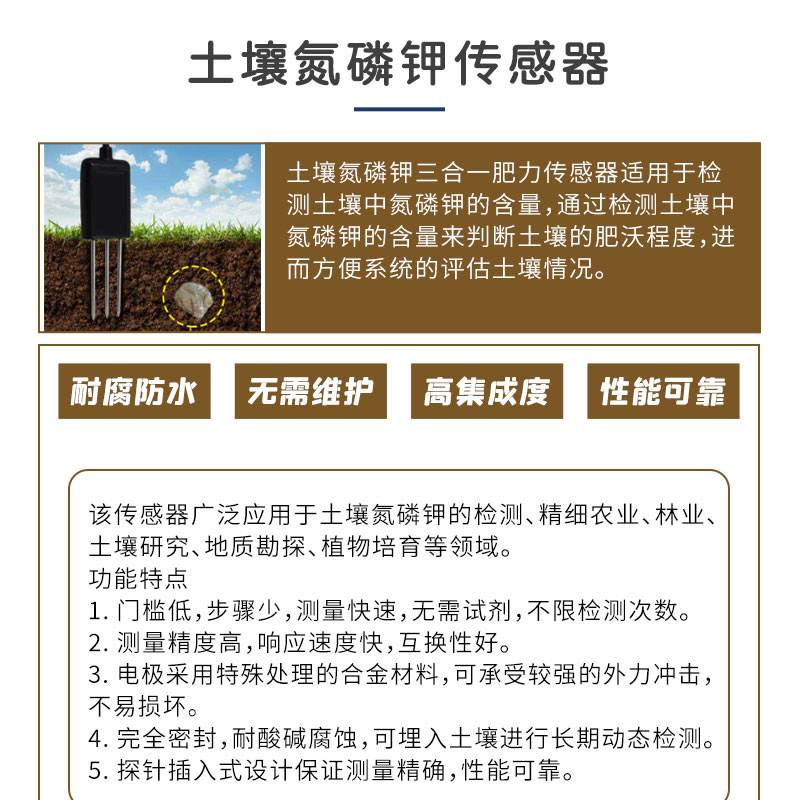
Smart agriculture projects require real-time monitoring of the soil, especially nitrogen, phosphorus and potassium levels, which helps to understand soil fertility, promote crop growth and increase agricultural yields.
Agriculture is transitioning to more scientific and precise growing methods, and the standards for cultivating crops are becoming more stringent. The use of sensors to accurately measure soil nutrients allows agricultural managers to accurately apply fertilisers accordingly, which both promotes healthy plant growth and pushes agriculture forward in the direction of intelligence.
Soil Nitrogen, Phosphorus and Potassium (NPK) sensors are specifically designed to detect chemical constituents in soil and fertilisers, and are able to quickly determine the amount of NPK in the soil. Using these sensors to assess soil nutrient levels can help us to understand the nutrient status of the soil, which in turn allows us to effectively use the natural nutrients in the soil and target deficient nutrients to optimise soil fertility.
Nitrogen, phosphorus and potassium are essential for plant growth. They are involved in the formation of essential organic substances in plants and activate enzymes for growth and metabolism. Every physiological process in plants requires the synergistic action of these elements, which work together to maintain proper plant development.
Designed for long-term soil monitoring, this sensor has excellent resistance to electrolysis and corrosion and is fully waterproof through vacuum encapsulation. It is used in a wide range of applications including soil nutrient determination, precision agriculture, forestry management, soil science research, geological exploration and plant breeding.
rainfall measuring measures mainly collect the water that falls on them and record changes in the depth of rainfall over time, usually expressed in millimeters....
In the Internet era, soil moisture monitoring systems can be revitalized by combining with technologies such as the Internet of Things, big data and artificial intelligence. For example, real-time monitoring and remote transmission of soil moisture data can be realized by using IoT technology. By de...
ambient weather company is a weather station and software manufacturer based in China, specializing in providing customized weather solutions and products for homes and businesses....
The establishment and use of automatic weather station, Windway Technology automatic weather station is a multi-factor weather station, which can operate normally all day long under unattended and harsh environment. It consists of two major parts: data collection system and communication network, wh...


 Skype
Skype
 whatsapp
 mail
mail