Shandong Fengtu IOT Technology Co., Ltd
Sales Manager:Ms. Emily Wang
Cel,Whatsapp,Wechat:+86 15898932201
Email:info@fengtutec.com
Add:No. 155 Optoelectronic Industry Accelerator, Gaoxin District, Weifang, Shandong, China


Sales Manager:Ms. Emily Wang
Cel,Whatsapp,Wechat:+86 15898932201
Email:info@fengtutec.com
Add:No. 155 Optoelectronic Industry Accelerator, Gaoxin District, Weifang, Shandong, China
time:2024-07-02 08:57:27 source:Weather Station viewed:887 time
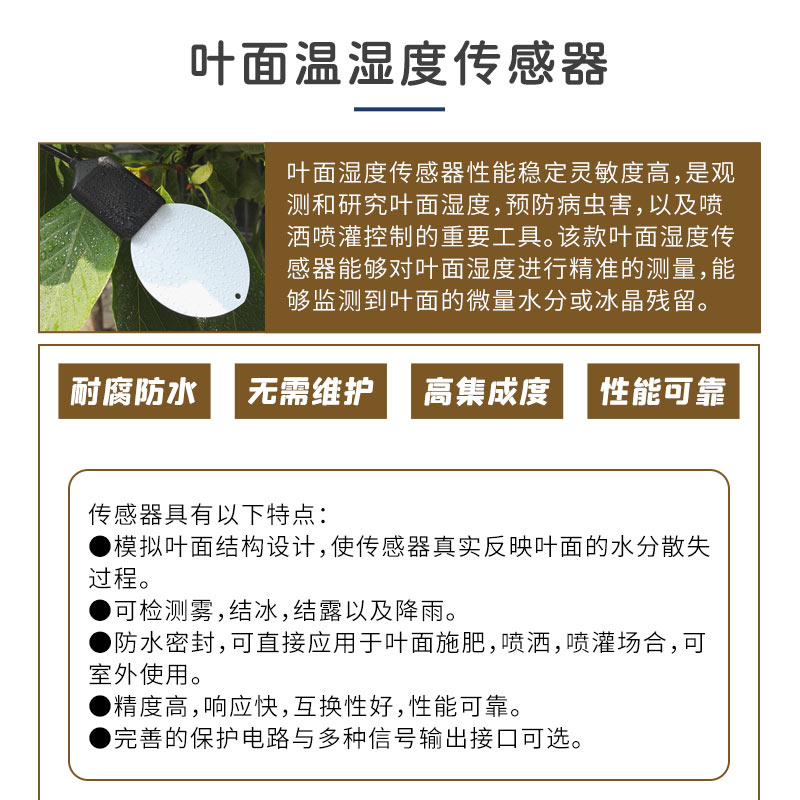
The Foliage Temperature and Humidity Sensor is a highly accurate measurement tool specifically designed to accurately monitor moisture levels on plant leaves, including tiny water or ice crystals. The shape of this sensor mimics a real leaf, a design that allows it to more realistically simulate and reflect the state of the foliage environment.
It uses changes in the dielectric constant of the upper surface of the mimic leaf medium to detect the presence of moisture or ice, a method that provides accurate measurements. The sensor's low energy consumption makes it suitable for continuous monitoring over long periods of time. The installation process is simple and can be easily suspended from a greenhouse shelf or fixed to a weather station pole for use in a variety of environments.
The level of moisture on the surface of plant leaves plays a key role in their susceptibility to pathogens. When a certain amount of moisture is present on the surface of the leaves, they are more susceptible to fungal and bacterial attack. Especially during disease development, if the leaf surface remains moist, this will provide favourable conditions for pathogen attack. Once the leaves are attacked by pathogens, not only will the health of the plant be affected, but damage may also be caused to the physiological structure of the leaves. Therefore, monitoring and controlling the humidity of plant leaves is important for the prevention and control of plant diseases.
Foliar temperature and humidity sensors are able to accurately measure the level of humidity on the leaf surface and its duration, as well as analysing the effect of the wet state on pesticide efficacy, which is crucial for pest control. This monitoring capability helps to predict disease risk, enabling farmers to implement preventive measures in advance to protect crops from disease.
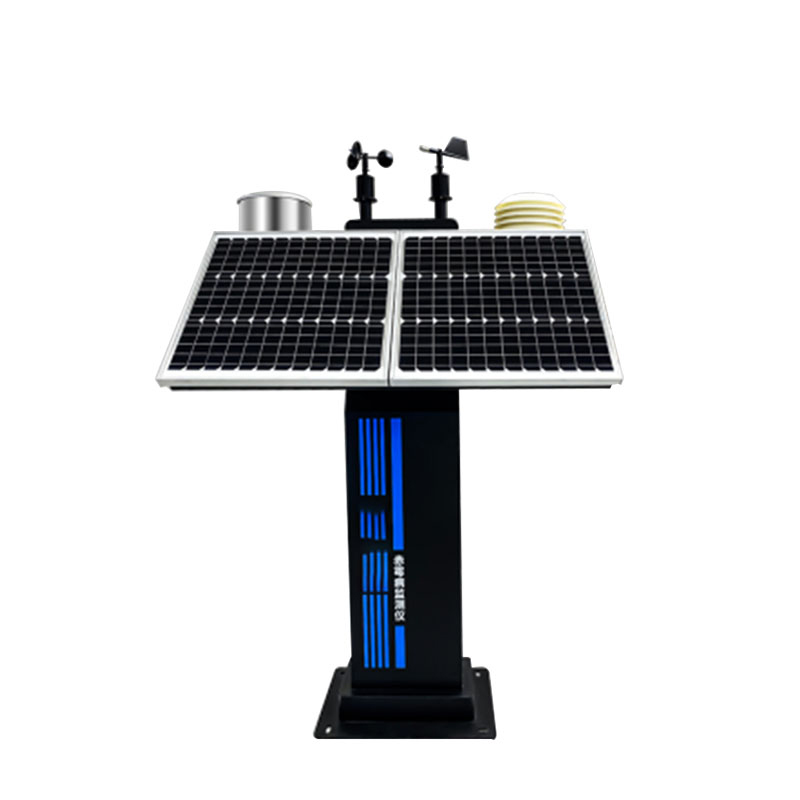
instruments of weather and their uses Instruments of weather and their uses There are many instruments that collect weather data, usually the following: thermometers, barometers, hygrometers, anemometers, total radiometers, etc....
The safety of reservoir dams is crucial to the lives and property of people in downstream areas, making it essential to establish a scientific and systematic monitoring system. It mainly consists of four core components: deformation monitoring, seepage monitoring, meteorological monitoring, and term...
In dam displacement monitoring, the distance between GNSS points—defined by the baseline length—is a critical control parameter. It is recommended that the spacing between the reference station and the monitoring station be kept within 500 meters, with a maximum baseline not exceeding 2,000 meters...
Water level automatic monitoring system is recommended FT-SW1, which is a device for automatic monitoring of river water level data launched by the manufacturer Windway Technology for the market, with a high degree of automation and independent operation in the field, without the need to send someon...


 Skype
Skype
 whatsapp
 mail
mail