Shandong Fengtu IOT Technology Co., Ltd
Sales Manager:Ms. Emily Wang
Cel,Whatsapp,Wechat:+86 15898932201
Email:info@fengtutec.com
Add:No. 155 Optoelectronic Industry Accelerator, Gaoxin District, Weifang, Shandong, China


Sales Manager:Ms. Emily Wang
Cel,Whatsapp,Wechat:+86 15898932201
Email:info@fengtutec.com
Add:No. 155 Optoelectronic Industry Accelerator, Gaoxin District, Weifang, Shandong, China
time:2024-07-12 08:52:22 source:Weather Station viewed:864 time
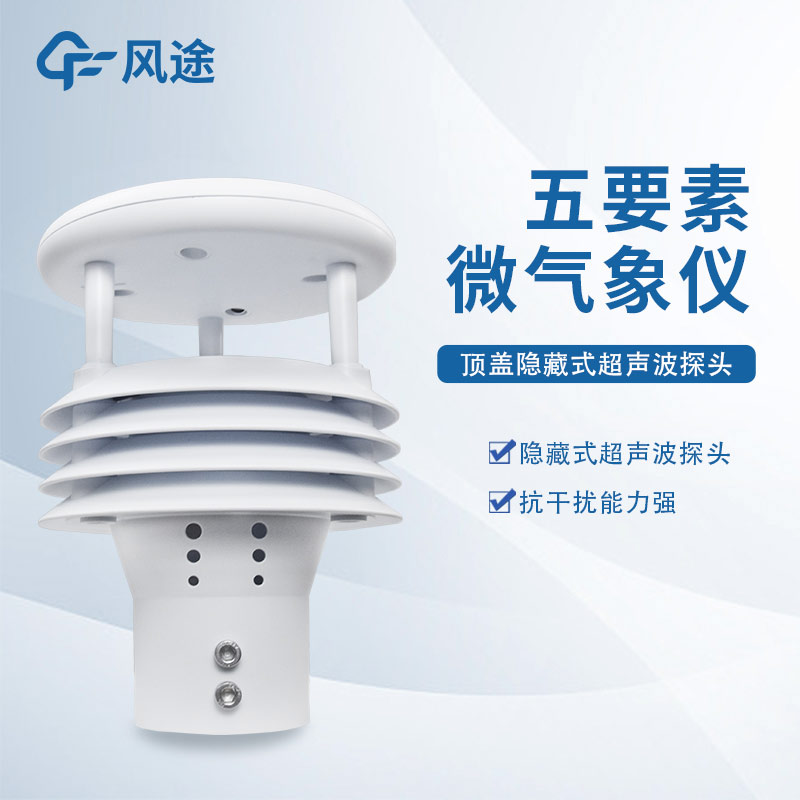
The Compact Multi-Parameter Automatic Weather Monitoring Station is a small-sized device that integrates numerous weather monitoring technologies. Favoured for its lightweight form factor and easy installation process, it allows for rapid deployment in diverse environments for continuous weather condition monitoring. The device captures and delivers critical weather data instantly, providing organisations and professionals with rapid and accurate weather intelligence to facilitate more efficient decision-making and management processes.
The device is equipped with an ultrasonic wind speed and direction monitor, radar rainfall detector, ambient temperature and humidity sensor, atmospheric pressure gauge, light intensity meter, UV radiometer and PM2.5 monitor. Known for its light weight and rugged construction, it requires no maintenance or field calibration and is capable of providing multiple data parameters simultaneously. Data output is carried out via RS485 format, ensuring seamless connectivity with computers, data collectors, or compatible communication devices for automatic weather stations supplied by our company.
The device determines wind speed and direction by measuring the propagation time of the ultrasonic signal from the northward-facing sensor (N) to the southward-facing sensor (S) and vice versa from S to N. The device is capable of measuring wind speed and direction from the northward-facing sensor (N) to the southward-facing sensor (S) and vice versa. Similarly, it compares the time the ultrasound travels from the westward-facing sensor (W) to the eastward-facing sensor (E) with the time it travels from E to W. For example, when the wind is blowing from the north, the ultrasonic propagation time from the N sensor to the S sensor will be shorter than the time from S to N, whereas the propagation times from W to E and from E to W remain the same. By analysing the difference in ultrasonic propagation time between the two points, wind speed and direction can be accurately calculated. This measurement technique is not disturbed by other environmental factors.
The device can be used with software that integrates a variety of functional modules, including standard mode, data acquisition, data presentation, graphical interface, and data storage. It allows the user to query real-time and historical data over any time range, supports data export functions, and can download data reports.
Corrosion-resistant radar level gauge is a kind of instrument used to measure the height of liquid level in liquid container. It uses radar technology to send and receive microwave signals to measure the liquid level height by measuring the propagation time of the microwave signals or the echo stren...
The integrated rainfall monitoring station is a new type of equipment for real-time monitoring and analysis of precipitation in the region. The equipment adopts different types of rain sensors to automatically collect rainfall data and transmit them to the monitoring center through the network. As a...
The safety of reservoir dams is crucial to the lives and property of people in downstream areas, making it essential to establish a scientific and systematic monitoring system. It mainly consists of four core components: deformation monitoring, seepage monitoring, meteorological monitoring, and term...
Moisture describes the level of moisture in the soil, which reflects the actual water content in the soil and is critical to plant growth. There are three key indicators of soil moisture: the maximum saturated water content of the soil, which is the degree to which the soil can become completely sat...


 Skype
Skype
 whatsapp
 mail
mail