Shandong Fengtu IOT Technology Co., Ltd
Sales Manager:Ms. Emily Wang
Cel,Whatsapp,Wechat:+86 15898932201
Email:info@fengtutec.com
Add:No. 155 Optoelectronic Industry Accelerator, Gaoxin District, Weifang, Shandong, China


Sales Manager:Ms. Emily Wang
Cel,Whatsapp,Wechat:+86 15898932201
Email:info@fengtutec.com
Add:No. 155 Optoelectronic Industry Accelerator, Gaoxin District, Weifang, Shandong, China
time:2026-04-13 09:40:24 source:Weather Station viewed:250 time
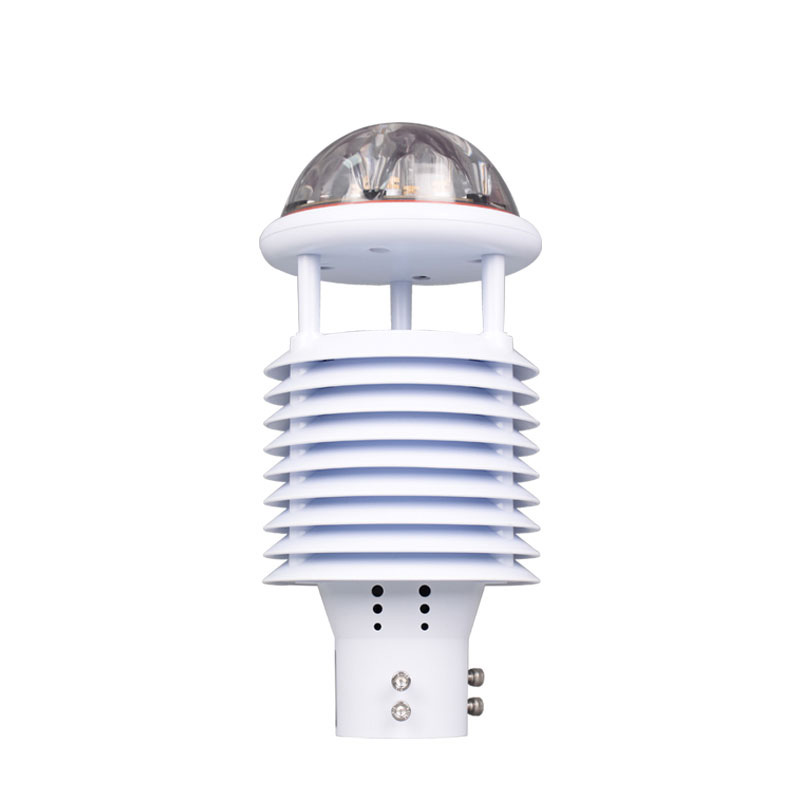
Multifunctional Weather Monitor is a highly integrated meteorological observation device capable of simultaneously monitoring 12 parameters, including six pollutants—PM2.5, PM10, CO, SO2, NO2, and O3—as well as temperature, humidity, wind speed, wind direction, atmospheric pressure, and optical rainfall. It is suitable for deployment in grid-based environmental monitoring networks, smart streetlights, scenic areas, factories, construction sites, roadways, and similar locations.
Multifunctional Weather Monitor is a highly integrated meteorological observation device that consolidates multiple meteorological elements into a single unit. Featuring a unified 12-element sensor design, the device enables real-time monitoring of the six aforementioned pollutant parameters, alongside air temperature, air humidity, wind speed, wind direction, atmospheric pressure, and optical rainfall—totaling 12 parameters in all. The sensor housing is constructed from imported ABS material, providing effective resistance against harsh environmental conditions such as salt spray. With an IP65-plus protection rating, the device operates reliably in all weather conditions—unaffected by heavy rain, snow, or frost.
In terms of technical specifications, the Multifunctional Weather Monitor features a wind speed measurement range of 0 to 60 m/s, a wind direction range of 0 to 360°, an air temperature range of -40 to 80°C, and a humidity range of 0 to 100% RH. Atmospheric pressure is measured within a range of 300 to 1100 hPa; PM2.5 and PM10 measurements both span 0 to 1000 μg/m³; optical rainfall is measured from 0 to 4 mm/min; the CO measurement range is 0 to 1000 ppm; and the measurement ranges for SO2, NO2, and O3 are all 0 to 20 ppm. The device supports an RS485 communication interface and the MODBUS protocol, with an optional wireless transmission module available; the minimum data transmission interval is 1 minute.
Multifunctional Weather Monitor is suitable for application in various settings requiring air quality monitoring, including urban grid-based environmental monitoring and control systems, smart streetlights, scenic area environmental monitoring, factories or mining sites, construction sites (specifically for dust monitoring), urban roadways, highways, and public spaces. This system is equally applicable to locations requiring real-time monitoring of current meteorological conditions—such as weather stations, buildings, docks, harbors, and outdoor recreational areas. Its primary function is to conduct continuous, 24-hour online monitoring of standard atmospheric pollutants and auxiliary meteorological parameters. The analyzed data is provided to environmental protection agencies to serve as a reference for assessing air quality and to support environmental decision-making. Furthermore, the device offers optional modules for monitoring additional parameters—including hydrogen sulfide, volatile organic compounds (VOCs), solar radiation, and noise levels—thereby meeting the diverse and expanded requirements of various operational scenarios.
The Multifunctional Weather Monitor unit features rapid installation and is designed for convenient use in field monitoring applications, finding widespread application across numerous sectors such as agriculture, environmental protection, scientific research, emergency response, and outdoor sports. The device employs ultrasonic technology to measure wind speed and direction; its top-mounted, concealed ultrasonic probes prevent interference caused by the accumulation of rain or snow. With no minimum start-up wind speed, no moving parts, and zero mechanical wear, the unit requires no on-site calibration, thereby significantly reducing long-term operation and maintenance costs. Utilizing wireless transmission technology, the system relays data back to a central monitoring center in real time, effectively addressing the limitations of traditional fixed weather stations regarding spatial coverage and agile response capabilities.
Rainwater online monitoring system can effectively monitor the rainfall situation in real time, and also has data storage and analysis functions, which plays a very important role in rainfall warning and flood prediction. Windway Technology is a manufacturer of rainwater online monitoring system, pr...
An air quality monitoring station is a technical system used for real - time monitoring of pollutant concentrations in the atmosphere. It can monitor air quality in real - time and give early warnings of pollution incidents. This system typically consists of sensors, data acquisition devices, data t...
FT-WQX2 Ultrasonic Wind Speed Direction Sensor applies the principle of ultrasonic time difference method. By transmitting continuous frequency-modulated ultrasonic signals, it utilizes the characteristic that the propagation speed of ultrasonic waves in the air is affected by wind speed to measure...
Soil is a key natural resource and is vital for crop growth. Crops are affected by dry or excessively wet soils, and economic and social development and climate change have exacerbated the problem of drought, leading to increased water scarcity and associated disaster losses. In hilly and forested a...


 Skype
Skype
 whatsapp
 mail
mail