Shandong Fengtu IOT Technology Co., Ltd
Sales Manager:Ms. Emily Wang
Cel,Whatsapp,Wechat:+86 15898932201
Email:info@fengtutec.com
Add:No. 155 Optoelectronic Industry Accelerator, Gaoxin District, Weifang, Shandong, China


Sales Manager:Ms. Emily Wang
Cel,Whatsapp,Wechat:+86 15898932201
Email:info@fengtutec.com
Add:No. 155 Optoelectronic Industry Accelerator, Gaoxin District, Weifang, Shandong, China
time:2022-12-27 14:19:54 source:Weather Station viewed:938 time
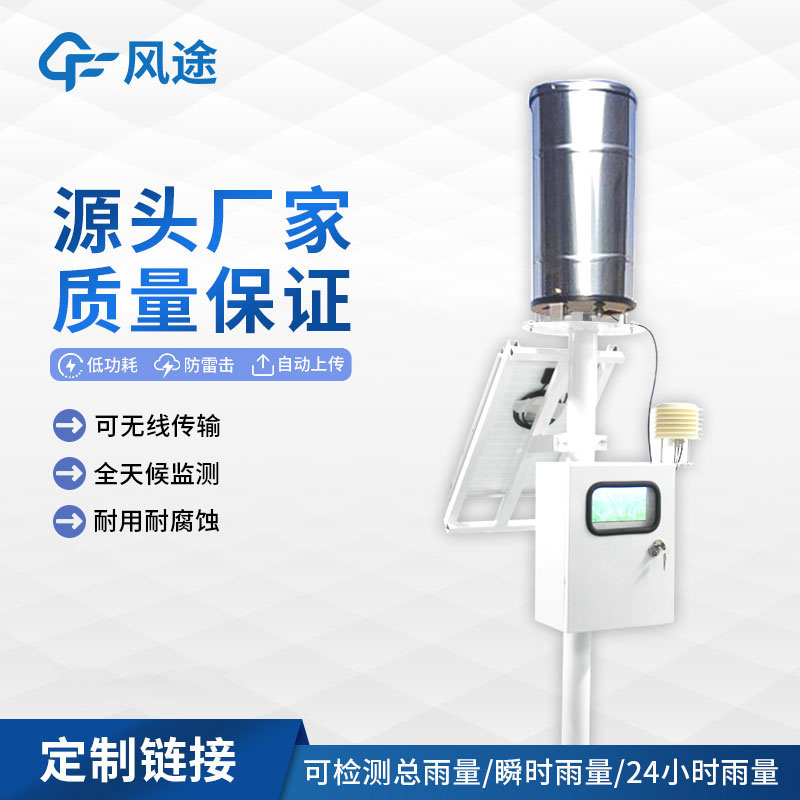
The rainfall real-time monitoring system is widely used in hydrology, meteorology and flood control. It consists of rain gauge, data collector and computer. By analyzing and processing the rainfall information collected from the automatic monitoring stations, the rainfall value of each rainfall monitoring station is obtained and the result is transmitted to the central station and the user terminal so that they can keep abreast of the rainfall situation at each point.
As a modern measurement means, the rainfall real-time monitoring system can improve the working efficiency and reduce human errors; meanwhile, it can also provide important decision-making basis for flood prevention and disaster reduction. It can also realize automatic observation and control, which has high practical value and is one of the directions of the development of modern water measurement and reporting.
The rainfall real-time monitoring system includes three parts: sensor module, data transmission module and data processing software. Among them, the sensor module is mainly responsible for receiving various signals from various monitoring points such as precipitation stations (e.g. rainfall barrels) or weather stations, and then sending them to the data transmission module after amplification, filtering and analog-to-digital conversion. The data transmission module is to convert the above data signals into digital signals by A/D converter and send them to PC for display, storage, query and printing.
Rainfall real-time monitoring system generally adopts distributed structure, that is, each monitoring point is installed with a rainfall sensor. This system is simple in structure and easy to maintain. When the precipitation exceeds a certain value, the device will send out an alarm signal to remind people to pay attention.
Weather changes affect humans everywhere. Not to mention agriculture, which depends on the weather, urban traffic safety is also constrained by the weather. Inclement weather, such as rain, snow and igloos, are simply road killers and are important factors affecting traffic safety. Therefore, in ord...
rainfall measuring measures mainly collect the water that falls on them and record changes in the depth of rainfall over time, usually expressed in millimeters....
A meteorological monitoring instrument is an intelligent instrument that integrates six standard meteorological parameters into a single device. This device integrates six meteorological elements—ambient temperature, relative humidity, wind speed, wind direction, atmospheric pressure, and opt...
FT-S3 is a Water PH Sensor suitable for industrial use. Why is that? In terms of measurement principle, FT-S3 utilizes the electrochemical (salt bridge) principle. Its core components include a glass electrode highly sensitive to hydrogen ions (H⁺) and a reference electrode composed of an Ag/AgCl e...


 Skype
Skype
 whatsapp
 mail
mail