Shandong Fengtu IOT Technology Co., Ltd
Sales Manager:Ms. Emily Wang
Cel,Whatsapp,Wechat:+86 15898932201
Email:info@fengtutec.com
Add:No. 155 Optoelectronic Industry Accelerator, Gaoxin District, Weifang, Shandong, China


Sales Manager:Ms. Emily Wang
Cel,Whatsapp,Wechat:+86 15898932201
Email:info@fengtutec.com
Add:No. 155 Optoelectronic Industry Accelerator, Gaoxin District, Weifang, Shandong, China
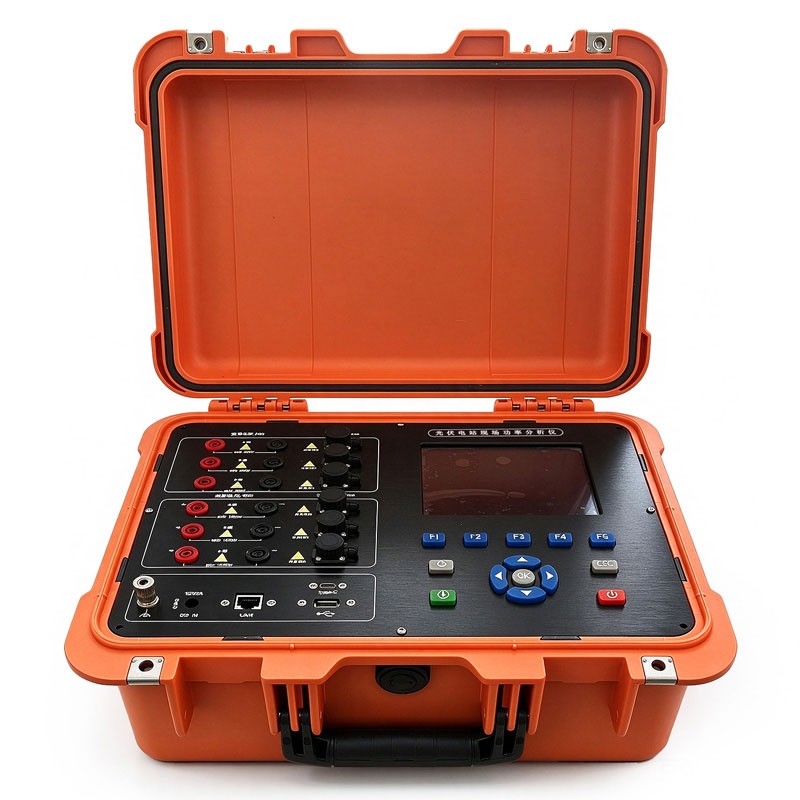
Model:FT-PE93
Brand:fengtu
1、PV Plant Inverter Efficiency Analyzer Product Overview
PV Plant Inverter Efficiency Analyzer monitors the power output of inverters at photovoltaic power plant sites, enabling the assessment of their energy conversion efficiency under various operating conditions.PV Plant Inverter Efficiency Analyzer is designed for electrical performance testing of inverter systems in photovoltaic (PV) power plants, enabling real-time monitoring of power output on-site. PV Plant Inverter Efficiency Analyzer utilizing current clamps for current sampling, the device can simultaneously capture electrical parameters from the DC side of the PV array and the AC side of the inverter while the plant is in normal operation. When paired with an irradiance meter to measure solar irradiance and PV module temperature, it can calculate the real-time conversion efficiency of the PV array, facilitating the prompt identification of underperforming modules or anomalous power generation units.
The main unit features a 5.7-inch color touchscreen LCD and supports dual-input operation via both the touchscreen and a physical keypad. The menu interface is clean and intuitive, allowing users to get started quickly—even without prior familiarity with the instrument. It is powered by a built-in lithium battery and supports remote test control. Furthermore, measurement data files can be copied directly to a USB flash drive, streamlining on-site data organization and subsequent analysis.
2、PV Plant Inverter Efficiency Analyzer Measurement Parameters
DC Voltage: Measurement range 0–1500 V; accuracy ±0.5% of reading ±0.2 V.
AC Voltage: Measurement range 0–1000 V; accuracy ±0.5% of reading ±0.2 V.
DC Current: Measurement range determined by the connected current clamp (up to 1500 A); accuracy ±0.5% of reading ±0.06% of full scale (FS).
AC Current: Measurement range determined by the connected current clamp (up to 1500 A); accuracy ±0.5% of reading ±0.06% of full scale (FS).
Frequency: Measurement range 42.5 Hz–69 Hz; accuracy ±0.2% of reading ±0.1 Hz.
Inverter Conversion Efficiency: Measurement range 10%–100%; accuracy ±1% of reading.
Power Factor: Measurement range 0.2–1; accuracy ±0.01.
Voltage Harmonics: Measurement range 1st–50th order; accuracy ±0.5% of reading ±0.5 V.
Irradiance and Temperature: Capable of measuring the irradiance on the surface of solar PV modules, the temperature on the back of the modules, and the ambient temperature; these data are used for irradiance and temperature correction in efficiency calculations.
3、PV Plant Inverter Efficiency Analyzer Hardware Specifications
Display: 5.7-inch color LCD touchscreen with a resolution of 640×480; high-brightness design, readable under sunlight.
Measurement Ports: 3 DC voltage, 3 DC current, 3 AC voltage, and 3 AC current measurement ports (6 test channels in total).
User Interface: Chinese/English; supports both touchscreen and keypad operation.
Main Unit Power Supply: AC/DC adapter (input: 100V–240V, 1.6A; frequency: 50/60Hz); DC 12.6V (2A); built-in lithium battery providing over 6 hours of operation (at room temperature and low brightness).
Probe Box Power Supply: 4 x AAA 1.5V batteries.
Dimensions: 385mm × 300mm × 200mm (W × H × D, main unit).
Weight: Approx. 8kg (main unit).
Operating Temperature: -10°C to +50°C (battery charging range: +5°C to +40°C).
Storage Temperature: -20°C to +60°C (excluding batteries).
Relative Humidity: 5% to 95%, non-condensing.
Calibration Interval: 12 months (recommended).
4、PV Plant Inverter Efficiency Analyzer Product Features
1. Features a high-brightness, sunlight-readable color LCD screen with both touchscreen and keypad controls. The intuitive, well-organized menu system ensures ease of use and allows for a quick mastery of all functions.
2. Equipped with measurement ports for 3 channels of DC voltage, 3 channels of DC current, 3 channels of AC voltage, and 3 channels of AC current, enabling the simultaneous acquisition of multiple electrical parameters.
3. Capable of measuring the DC voltage and current output of photovoltaic (PV) arrays, as well as the AC voltage and current output of inverters.
4. Measures active power and power factor on the DC side of the inverter, and calculates the inverter's real-time conversion efficiency.
5. Performs voltage harmonic analysis and frequency detection, assisting in the assessment of grid power quality and the operational status of the inverter.
6. Measures and displays solar irradiance on the surface of PV modules, as well as the temperature on the back of the modules and the ambient temperature—providing the necessary data for efficiency calculation adjustments.
7. Supports remote test control and can be networked with an irradiance meter for synchronized operation, facilitating coordinated, large-scale testing.
8. Includes an intelligent battery level indicator; supports file copying, allowing data files stored on the device to be transferred directly to a USB flash drive.
Test Conditions: Unless otherwise specified, all performance specifications are based on a temperature of 23°C ± 5°C, with measurements taken after the device has been powered on for at least 30 minutes. For calibrated instruments, performance is guaranteed after the unit has been kept within an operating temperature range of -10°C to 50°C for at least 2 hours, followed by a 45-minute warm-up period.
The miniature meteorological instrument is a comprehensive meteorological sensor for use in a wide range of environments, which can simultaneously measure temperature, humidity, atmospheric pressure, wind speed and other meteorological elements for detecting meteorological conditions and environment...
Field microclimate refers to a small local area, which is the most important environmental condition affecting crop growth and development and yield formation. By analyzing the distribution and characteristics of microclimate elements in farmland through field microclimate observation stations, we c...
Soil moisture is a measure of soil moisture and is extremely critical to agricultural production as it directly affects the growing conditions of crops. Moisture content is measured by the percentage of soil water content, which can be expressed as the ratio of the weight of water in the soil to the...
Agricultural sensors are a very critical technology in smart agriculture. This technology was patented and researched from 1917 until 2006, when 47 related patents were filed globally.After 2006, with the rapid development of information agriculture, there was a significant advancement in agricultur...


 Get a Free Quote
 Skype
 whatsapp
 mail