Shandong Fengtu IOT Technology Co., Ltd
Sales Manager:Ms. Emily Wang
Cel,Whatsapp,Wechat:+86 15898932201
Email:info@fengtutec.com
Add:No. 155 Optoelectronic Industry Accelerator, Gaoxin District, Weifang, Shandong, China


Sales Manager:Ms. Emily Wang
Cel,Whatsapp,Wechat:+86 15898932201
Email:info@fengtutec.com
Add:No. 155 Optoelectronic Industry Accelerator, Gaoxin District, Weifang, Shandong, China
time:2025-12-15 09:29:54 source:Weather Station viewed:625 time
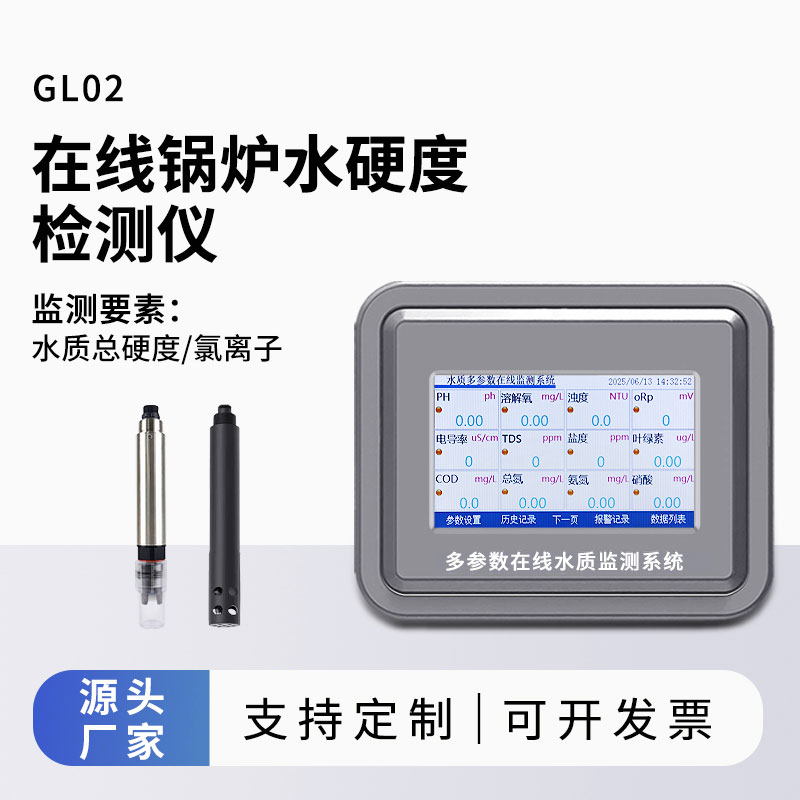
Online water quality total hardness monitor utilizes the ion-selective electrode method for continuous online monitoring of total water hardness and chloride ion content. The monitoring results can be used to control the start and stop of water softening equipment, making it suitable for applications suchs as softened water output, boiler feedwater, and circulating cooling water, achieving automated operation and real-time data feedback.
Online water quality total hardness monitor is a professional device for continuous online monitoring of total hardness and chloride ion content in water. Based on the ion-selective electrode method, this instrument provides real-time water quality data and automatically controls the operation of associated water softening equipment based on preset hardness thresholds. It is primarily used in industrial water treatment applications, such as monitoring the water quality of softened water output, monitoring boiler feedwater hardness, and water quality management in circulating cooling water, demineralized water, and deionized water systems.
The instrument's core technology is the ion-selective electrode method. This method uses specific electrodes to selectively respond to calcium and magnesium ions (the main ions constituting total hardness) and chloride ions in the water sample, converting ion activity into electrical signals, and then calculating the corresponding concentration values. This measurement method is highly specific, has a fast response speed, and meets the real-time requirements of continuous online monitoring. The instrument is usually equipped with a flow-through sampling cell or an immersion probe for continuous water sample analysis and data output.
Functionally, this monitoring instrument not only performs water quality monitoring but also implements process control. It can transmit the measured total hardness value to the control system in real time. When the hardness value exceeds the set upper limit, the instrument can output a signal to automatically start the softening regeneration program or trigger an alarm; when the hardness drops to a safe range, it can automatically stop the softening equipment. This closed-loop control logic automates the water softening process, reduces manual intervention, and avoids the risk of equipment scaling caused by uncontrolled hardness.
This monitoring instrument is suitable for various water quality online monitoring scenarios. In boiler water systems, continuous monitoring of feedwater hardness is a key measure to prevent boiler scaling and ensure thermal efficiency and safe operation. In industrial softened water processes, the monitoring instrument directly evaluates the effectiveness of the softener, ensuring resin exchange efficiency. For circulating cooling water and demineralized water stations, it provides continuous water quality data to help maintain system stability. Once properly configured and put into operation, the instrument can operate automatically for extended periods without daily manual intervention, reducing maintenance costs.
The instrument can display and transmit total water hardness data in real time. Measurement results are output via digital signals or standard industrial communication protocols, and can be integrated into a central control room, PLC system, or local display screen, providing quick and accurate feedback to operators. This real-time feedback mechanism allows staff to promptly monitor water quality dynamics, supporting production decisions and troubleshooting.
Overall, the Online water quality total hardness monitor instrument utilizes ion-selective electrode technology to achieve efficient online monitoring of key water quality parameters. Its integrated monitoring and control capabilities enhance the automation and reliability of industrial water treatment processes. This device is of great significance for preventing equipment scaling, optimizing softener operation, and ensuring the safety of boilers and other water systems, making it a practical and efficient water quality management tool in industrial water treatment processes.
how does a rain gauge work? Placed in an open area, it is measured based on the height of the precipitation that has accumulated in the container at a given time, and the change in rainfall over time is recorded....
npk sensor is used to measure the levels of nitrogen, phosphorus and potassium (NPK). Monitoring the content of nitrogen (N), phosphorus (P) and potassium (K) in the soil helps determine the fertility of the soil....
Industrial Meteorological Sensors play an important role in meteorological monitoring and research, and they have a rich variety of types, covering the measurement of multiple meteorological elements.Temperature sensors are a major category. Glass liquid thermometers rely on the thermal expansion an...
Soil is the cornerstone of agriculture, providing crops with the water, nutrients, air and temperature they need to grow. Soil formation is influenced by a number of factors, such as original soil composition, climate, biological action, topography and time of year, as well as human farming activiti...


 Skype
Skype
 whatsapp
 mail
mail