Shandong Fengtu IOT Technology Co., Ltd
Sales Manager:Ms. Emily Wang
Cel,Whatsapp,Wechat:+86 15898932201
Email:info@fengtutec.com
Add:No. 155 Optoelectronic Industry Accelerator, Gaoxin District, Weifang, Shandong, China


Sales Manager:Ms. Emily Wang
Cel,Whatsapp,Wechat:+86 15898932201
Email:info@fengtutec.com
Add:No. 155 Optoelectronic Industry Accelerator, Gaoxin District, Weifang, Shandong, China
time:2025-04-01 09:17:37 source:Weather Station viewed:730 time
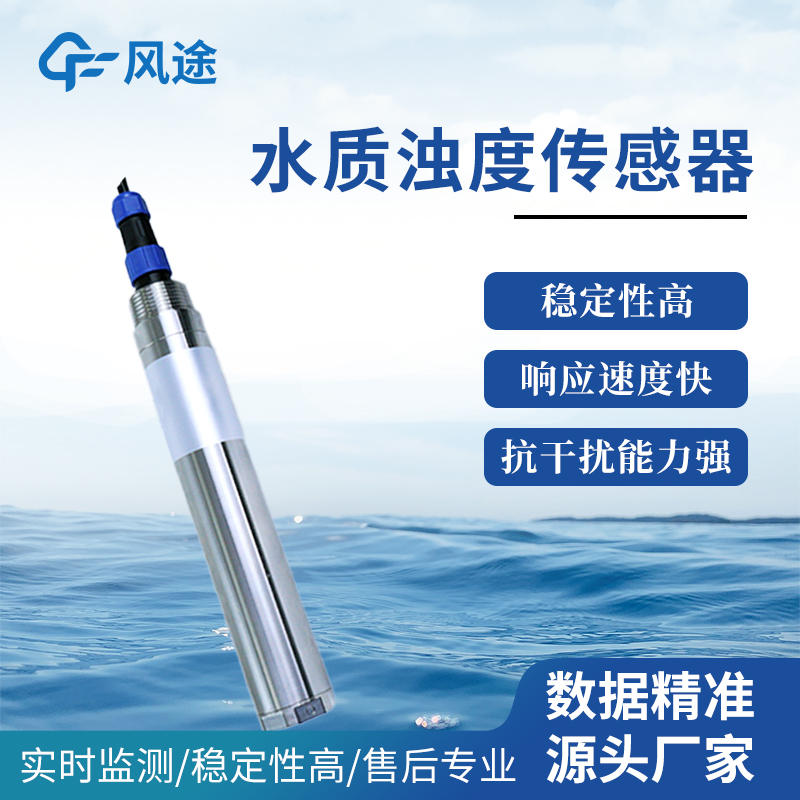
How to measure turbidity online? You can try this Online turbidity sensor.
The turbidity of water quality refers to the degree of water turbidity, which is caused by the presence of suspended particles, colloidal substances, etc. in the water. These suspended substances will scatter and absorb light, reducing the transparency of the water and making it look turbid. Turbidity is usually measured in NTU (Nephelometric Turbidity Unit). For example, the turbidity of drinking water generally should not exceed 1 NTU, and the turbidity of high-quality drinking water may be below 0.1 NTU.
Excessively high turbidity will affect the sensory properties of water, making the water look unappealing, and it may also have an impact on the living environment of aquatic organisms. Water with high turbidity may carry more bacteria, viruses, and other harmful substances, posing a potential threat to human health. In industrial production, such as in the pharmaceutical and food processing industries, there are strict control requirements for the turbidity of water quality, because excessively high turbidity may affect product quality.
How to measure turbidity online? You can try this Online turbidity sensor. Based on the 90° scattered light detection technology, it can continuously and real-timely monitor the turbidity of water bodies. When light shines on the suspended particles in the water, a scattering phenomenon will occur. The sensor calculates the concentration of suspended particles in the water by detecting the intensity of the scattered light, thus obtaining the turbidity value of the water. The 90° scattered light detection technology it adopts can effectively avoid the interference of direct light from the light source and reflected light, improving the accuracy of measurement. It is widely used in the fields of drinking water treatment, sewage treatment, industrial process water monitoring, and water environment monitoring of rivers and lakes.
An online oil cleanliness analyzer is a real-time monitoring device that uses the optical obscuration method and a high-precision laser sensor. It can be directly installed in hydraulic or lubrication system pipelines to automatically detect the number and size distribution of solid particles...
The 7-factor automatic weather station, which can collect 7 meteorological elements such as wind speed, wind direction, temperature, humidity, air pressure, light/total radiation, and optical rainfall in real time, provides basic data for meteorological services, and transmits to computer for data p...
light sensor can be used to measure illuminance, respond to changes in received light, detect light and convert it into current, with ultra-low light sensitivity and low power consumption....
Universal GNSS monitoring equipment employs differential RTK technology to achieve millimeter-level displacement monitoring. It is widely applicable across engineering fields—including dam safety monitoring, bridge structural health assessment, and landslide early warning systems—and feature...


 Skype
Skype
 whatsapp
 mail
mail