Shandong Fengtu IOT Technology Co., Ltd
Sales Manager:Ms. Emily Wang
Cel,Whatsapp,Wechat:+86 15898932201
Email:info@fengtutec.com
Add:No. 155 Optoelectronic Industry Accelerator, Gaoxin District, Weifang, Shandong, China


Sales Manager:Ms. Emily Wang
Cel,Whatsapp,Wechat:+86 15898932201
Email:info@fengtutec.com
Add:No. 155 Optoelectronic Industry Accelerator, Gaoxin District, Weifang, Shandong, China
time:2025-04-22 09:22:12 source:Weather Station viewed:996 time
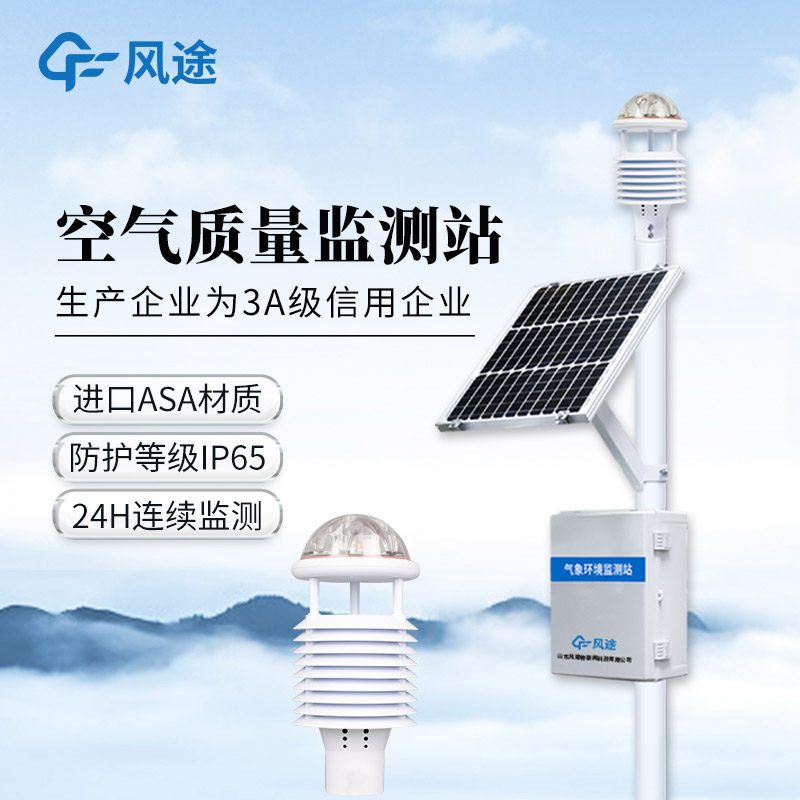
The quality of the atmospheric environment is closely related to the survival and development of human beings. Precise and real-time monitoring serves as the foundation for understanding the state of the atmospheric environment and formulating control measures. As important tools for atmospheric environment monitoring, the Air quality monitoring station and the Dust detector play a significant role in environmental supervision.
The Air quality monitoring station is capable of monitoring "four gases and two types of dust". The "four gases" refer to sulfur dioxide, nitrogen dioxide, carbon monoxide, and ozone, while the "two types of dust" are PM2.5 and PM10. Its advantage lies in its flexible deployment. According to the distribution of urban functional areas and pollution sources, it can be densely installed within the region to construct a grid-based monitoring network, achieving refined and comprehensive coverage of the monitoring of atmospheric pollutant concentrations. Through real-time data transmission and analysis, it can promptly identify pollution hotspots and the diffusion trends of pollutants, providing accurate decision-making bases for environmental management departments.
The Dust detector is mainly used to measure PM concentration and noise. In places prone to generating dust, such as construction sites and mining areas, it can monitor the real-time changes in the concentrations of PM2.5 and PM10 in the air, and also monitor the noise intensity on-site. This instrument has the functions of automatic data collection, storage, and remote transmission. Once the PM concentration or noise exceeds the set threshold, it will automatically alarm, making it convenient for relevant units to take timely dust and noise reduction measures, effectively controlling dust pollution and noise pollution, and ensuring the quality of the surrounding environment.
The Air quality monitoring station and the Dust detector provide data support for atmospheric environment monitoring from different dimensions. The former focuses on comprehensive monitoring of macroscopic regions, while the latter is dedicated to precise control of specific pollution sources. Complementing each other, they jointly contribute to the work of atmospheric environment monitoring, providing powerful technical support for improving air quality and promoting the construction of ecological civilization.
Boat Depth Finder Utilizing ultrasonic ranging principles for precise water depth calculation, this device is suitable for various environments—including rivers, lakes, reservoirs, and shallow coastal waters—and supports measurements in both still and flowing water. Integrating functions such as p...
best rated weather stations for home can monitor wind speed, wind direction, temperature, humidity, air pressure, pm2.5, pm10, noise and other meteorological elements....
The operation of highways is significantly affected by meteorological conditions, and inclement weather such as fog, snowstorms, typhoons and heavy rains can pose a greater threat to driving safety. Under these conditions, the passage of highways may be obstructed or even closed, seriously affecting...
Oil Pressure Sensor integrates four distinct technologies—Electrochemical Impedance Spectroscopy (EIS), Ultrasonic Viscosity Monitoring, Micro-moisture Detection, and Inductive Magnetic Field Analysis—to provide real-time assessment of lubricant health. It simultaneously monitors key paramet...


 Skype
Skype
 whatsapp
 mail
mail