Shandong Fengtu IOT Technology Co., Ltd
Sales Manager:Ms. Emily Wang
Cel,Whatsapp,Wechat:+86 15898932201
Email:info@fengtutec.com
Add:No. 155 Optoelectronic Industry Accelerator, Gaoxin District, Weifang, Shandong, China


Sales Manager:Ms. Emily Wang
Cel,Whatsapp,Wechat:+86 15898932201
Email:info@fengtutec.com
Add:No. 155 Optoelectronic Industry Accelerator, Gaoxin District, Weifang, Shandong, China
time:2024-07-25 08:37:32 source:Weather Station viewed:692 time
With advances in technology, facility-based agriculture is emerging as a model of agriculture that utilizes greenhouses and related equipment to control the environment in which crops are grown. It is characterized by high yield, high efficiency and high quality, and is a technology-intensive form of agriculture.
In facility agriculture, greenhouse monitoring and control systems are critical, and the selection and design of sensors is at the heart of this system. The performance of the sensor directly affects the accuracy and reliability of the data, which in turn affects the control effect of the entire greenhouse environment. Therefore, the selection of appropriate sensors is crucial for realizing efficient and accurate greenhouse management.
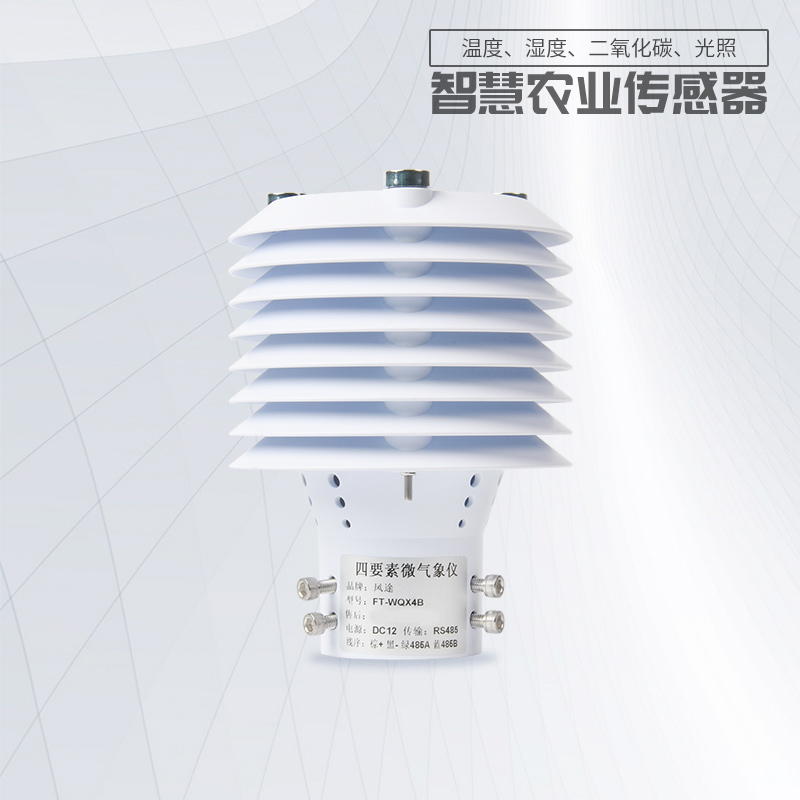
At present, the main sensors are temperature and humidity sensors, carbon dioxide sensors and so on. However, Fengtu's "Multi-factor Environment Monitor" is an integrated sensor that can simultaneously measure temperature, humidity, carbon dioxide, light and other data, providing an affordable and easy-to-use solution for greenhouses. Compact and intelligent, this device helps farmers manage the greenhouse environment more effectively, reduce labor costs, and realize the transition from traditional greenhouses to smart greenhouses. The device uploads monitoring data to the server via 4G network, so users can log in to the cloud platform to view and download data anytime, anywhere.
Greenhouse management is evolving from just monitoring environmental conditions to directly monitoring the crop itself. In the future, it may be possible to measure the physiological activities of the crop, such as temperature, photosynthesis, transpiration, as well as changes in the growth of plant stems and fruits. Such monitoring could help control CO₂ concentrations, irrigation, and nutrient supply in the greenhouse more precisely. The type and number of sensors used in greenhouses is increasing as demand grows. Windway is developing more sensors for greenhouses to support this more refined approach to crop management. This will make greenhouse agriculture more efficient and smarter.
The river water level monitoring system is a fully automated, online hydrological monitoring device based on microwave radar technology. It employs K-band planar radar to measure water levels without physical contact, remaining unaffected by temperature, sediment, pollutants, or floating debri...
A visibility detector is a device used to measure atmospheric visibility. It helps meteorologists, traffic controllers, pilots, and others to understand the current visibility conditions in the atmosphere so that they can make decisions accordingly.In meteorology, visibility is a key concept that de...
As industries such as transport, aviation and navigation continue to develop, weather phenomena such as atmospheric pollution and haze have become important factors in limiting the development of these industries. In this context, there is increasing interest in the use of visibility monitoring inst...
Measuring visibility is crucial for ensuring traffic safety, especially in fields such as highways, railways, aviation, and shipping. Low visibility significantly increases the risk of accidents. Visibility data is very important for improving the accuracy of weather forecasts, conducting climate re...


 Skype
Skype
 whatsapp
 mail
mail