Shandong Fengtu IOT Technology Co., Ltd
Sales Manager:Ms. Emily Wang
Cel,Whatsapp,Wechat:+86 15898932201
Email:info@fengtutec.com
Add:No. 155 Optoelectronic Industry Accelerator, Gaoxin District, Weifang, Shandong, China


Sales Manager:Ms. Emily Wang
Cel,Whatsapp,Wechat:+86 15898932201
Email:info@fengtutec.com
Add:No. 155 Optoelectronic Industry Accelerator, Gaoxin District, Weifang, Shandong, China
time:2026-08-06 08:53:24 source:Weather Station viewed:37 time
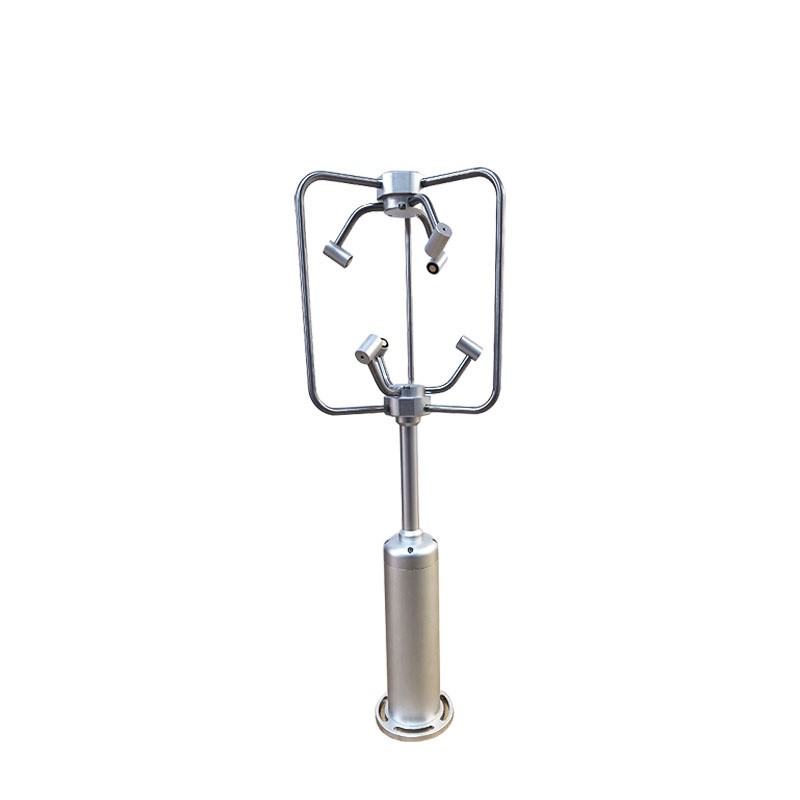
The triaxial anemometer employs ultrasonic time-of-flight detection, has no moving parts, and can output wind speed components along the X, Y, and Z axes. The device is adaptable to various harsh environments and is widely used for wind condition monitoring in wind power plants, airports, bridges, and tunnels.
The triaxial anemometer is a wind speed sensing device without moving parts, constructed entirely of metal. Its special structure reduces measurement interference caused by wind resistance, ensuring measurement accuracy. Internally, the device contains three sets of fixed-gap ultrasonic transducers. The transceiver circuit controls the transducers to alternately transmit and receive ultrasonic waves, comparing the propagation time of the sound waves under tailwind and headwind conditions to calculate the wind speed parameters along the three axes. Vector synthesis calculations are then used to obtain the overall wind speed value, and the horizontal and vertical wind direction data are analyzed separately.
The triaxial anemometer boasts standardized measurement parameters, with a composite wind speed measurement range of 0-60 m/s and independent triaxial wind speed ranges from -60 to 60 m/s. Wind direction measurement covers a horizontal range of 0-359° and a vertical range of -90 to 90°. All measurement parameters have a resolution of 0.01 m/s or 1°, with measurement errors controlled within specified limits. Because it lacks easily worn parts like impellers and shafts, the triaxial anemometer is less susceptible to interference from dust, low temperatures, and humidity, enabling continuous monitoring operations around the clock.
Its stable and reliable performance makes the triaxial anemometer suitable for various industry scenarios. Urban environmental monitoring stations rely on it to capture spatial airflow data; wind farms use it to obtain turbulence and vertical wind shear information; and bridges, tunnels, ships, and airports also rely on this equipment to collect three-dimensional wind condition data, providing accurate and effective measured data for wind environment assessment in various engineering projects.
Explosion-proof automatic weather station, mainly used for environmental monitoring and management in electric power, petroleum, chemical and other industries, is a meteorological observation instrument. It can monitor the changes of various meteorological data in the atmosphere exactly within a cer...
Introduction to Portable Mobile Visibility Monitoring Stations -A portable mobile visibility monitoring station is a portable device used to measure environmental visibility and is designed to provide accurate visibility data to help users assess current visual conditions and safety. The stations ty...
Settlement monitoring system utilizes differential RTK technology to achieve millimeter-level displacement monitoring, continuously observing vertical surface displacement through GNSS base stations and IoT sensor networks. This technology system can be widely applied in engineering fields suc...
Soil moisture, that is, the degree of wetness of soil, is very important for agricultural irrigation, environmental protection and disaster prevention. By establishing the Automatic Soil Monitoring System, we can more accurately understand the changes in soil moisture, so that we can more effectivel...


 Skype
Skype
 whatsapp
 mail
mail