Shandong Fengtu IOT Technology Co., Ltd
Sales Manager:Ms. Emily Wang
Cel,Whatsapp,Wechat:+86 15898932201
Email:info@fengtutec.com
Add:No. 155 Optoelectronic Industry Accelerator, Gaoxin District, Weifang, Shandong, China


Sales Manager:Ms. Emily Wang
Cel,Whatsapp,Wechat:+86 15898932201
Email:info@fengtutec.com
Add:No. 155 Optoelectronic Industry Accelerator, Gaoxin District, Weifang, Shandong, China
time:2026-06-30 09:34:24 source:Weather Station viewed:57 time
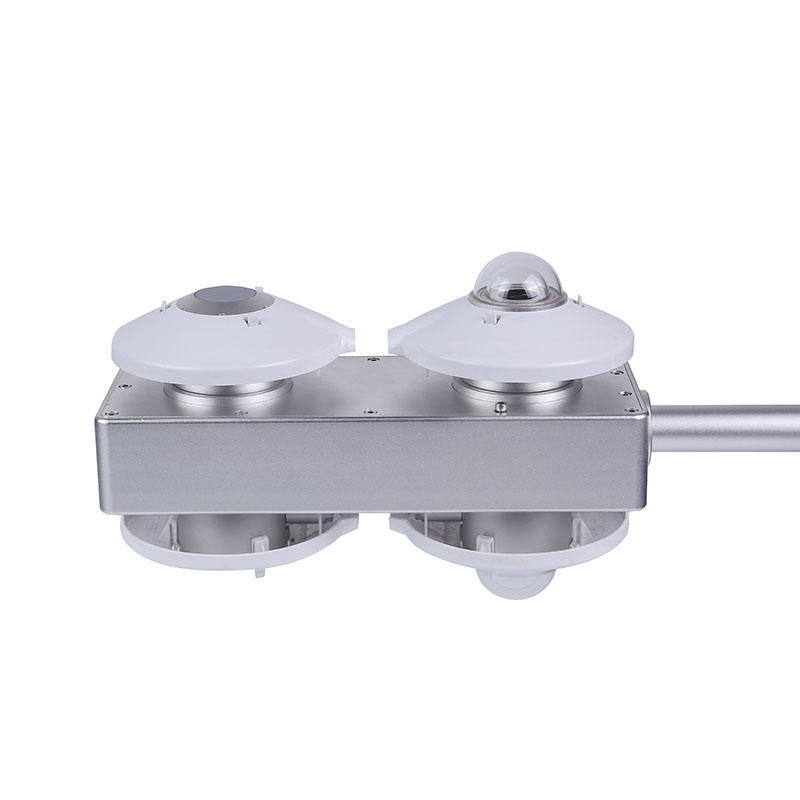
4-Component Net Radiometer consists of two shortwave and two longwave radiometers, one at the top and one at the bottom. It simultaneously measures the four components of downward and upward shortwave radiation and downward and upward longwave radiation. The net radiation flux at the Earth's surface is calculated and used for radiation energy balance observation and research in meteorology, agriculture, ecology, and other fields.
4-Component Net Radiometer is a specialized instrument for directly measuring the radiation energy balance in the environment, primarily serving meteorological observation, agricultural microclimate research, ecological flux monitoring, and industrial photovoltaic efficiency assessment. Its core working principle involves four independent thermopile radiometers that sense shortwave radiation (wavelength 285–3000 nm) from the sun and longwave infrared radiation (wavelength 400–50000 nm) from the Earth's surface and atmosphere. Two sensors face upward to receive downward radiation, and two face downward to receive upward reflected and emitted radiation, thus obtaining the four fundamental components of the radiation balance. Based on real-time measurements of these four components, the system can automatically calculate the net radiation, i.e., the net energy absorbed by the Earth's surface. This data is a key physical quantity for determining surface heating or cooling, evapotranspiration intensity, and atmospheric stability.
In terms of technical performance, the shortwave radiation measurement of 4-Component Net Radiometer meets the accuracy standard of a Class I instrument, with a time response (95%) of 13 seconds. Zero-point offsets caused by thermal radiation and temperature changes are controlled within ±10 W/m² and ±3 W/m², respectively. Nonlinearity error does not exceed ±1.5%, and annual stability is better than ±1%. The longwave radiation channel has a wider spectral range, a response time of less than 18 seconds, annual stability of less than 2%, and a temperature coefficient not exceeding ±1% within the range of -20℃ to +50℃. The viewing angle is 180° hemispherical. The entire instrument is equipped with 4 millivolt signal channels and 2 four-wire platinum resistance temperature sensor channels to compensate for the influence of instrument temperature changes on the measurement results. The operating temperature range covers -40℃ to +70℃, and the weight is approximately 9 kg, making it suitable for long-term unattended field observations.
In practical applications, sensors are typically erected above an open, flat surface at a certain height to simultaneously record incident solar shortwave radiation, surface-reflected shortwave radiation, downward atmospheric longwave radiation, and upward surface longwave radiation. By algebraically summing these four components, the positive or negative change in net radiative flux can be obtained; a positive value indicates energy gain at the surface, and a negative value indicates energy loss. This data is widely used to assess the modulation effect of clouds and water vapor on radiative transfer, calculate the energy exchange intensity of the Earth-atmosphere system, and provide fundamental radiative input parameters for predicting the power generation efficiency of photovoltaic power plants, controlling the solar and thermal activity of greenhouses, and estimating farmland evapotranspiration. Compared to single-meter methods or indirect extrapolation methods, independent measurement of the four components effectively separates the contributions of shortwave and longwave radiation, improving the accuracy of net radiation calculations. This is especially true under conditions of cloud cover, aerosols, or frequent changes in surface cover, where the data reliability advantage is even more pronounced. Currently, this type of sensor has become a standard configuration in ground-based radiation balance observation networks, providing stable fundamental data support for climate monitoring and local weather research.
instruments of the weather There are thermometers, hygrometers, anemometers, and barometers for measuring meteorological elements of the surrounding environment....
Buoy-type automatic water quality monitoring station, is a water quality monitor as the center, the use of sensor technology will be the buoy body, power supply system and data transmission equipment combined and constitute a small water quality monitoring system placed in the water.Buoy intelligent...
Based on microwave technology, the Water Level Monitoring System system automatically monitors water level, flow velocity, and flow rate through a sensor network, providing precise data for flood control and water management....
The establishment of small-scale automatic ambient air monitoring stations is important for real-time and accurate monitoring of air quality, tracking the spread and changes of pollutants, and it helps to present a comprehensive and objective picture of ambient air quality. This measure is essential...


 Skype
Skype
 whatsapp
 mail
mail