Shandong Fengtu IOT Technology Co., Ltd
Sales Manager:Ms. Emily Wang
Cel,Whatsapp,Wechat:+86 15898932201
Email:info@fengtutec.com
Add:No. 155 Optoelectronic Industry Accelerator, Gaoxin District, Weifang, Shandong, China


Sales Manager:Ms. Emily Wang
Cel,Whatsapp,Wechat:+86 15898932201
Email:info@fengtutec.com
Add:No. 155 Optoelectronic Industry Accelerator, Gaoxin District, Weifang, Shandong, China
time:2026-08-13 09:09:38 source:Weather Station viewed:35 time
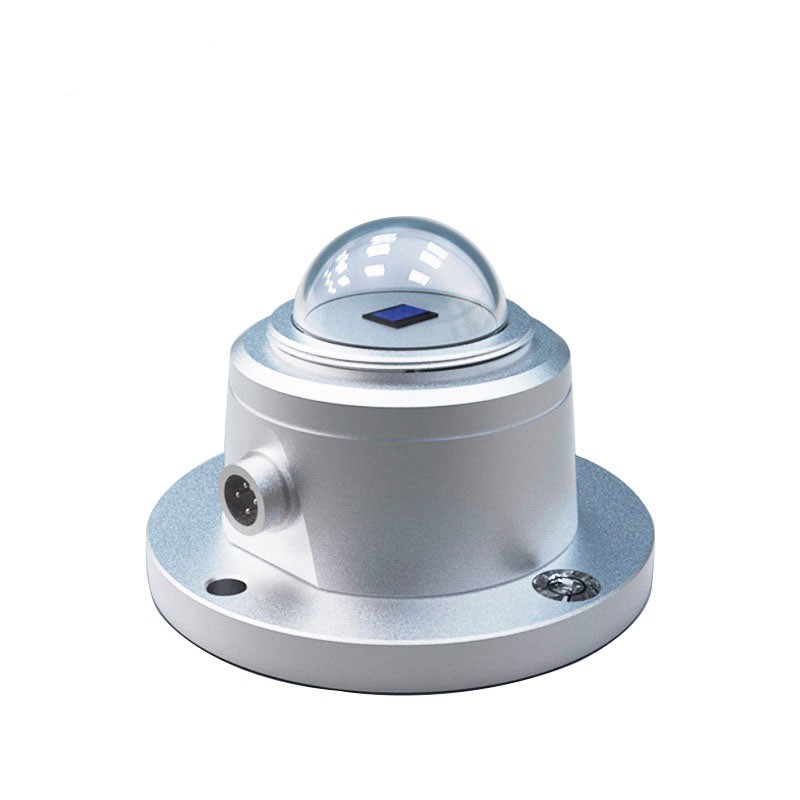
Equipped with RS485 communication, the Radiation sensor boasts low power consumption, adaptability to a wide range of temperature environments, and accurate irradiance data collection, serving meteorological, photovoltaic, agricultural, and building energy conservation monitoring needs.
The Radiation sensor is a dedicated monitoring device for collecting solar radiation energy. It uses a photosensitive element to receive sunlight and convert it into a readable electrical signal, outputting stable irradiance monitoring data, suitable for environmental monitoring operations in multiple industries. The device uses a DC 12V power supply, with an overall power consumption of only 0.036W and a working current of 3mA. This low power consumption allows it to meet the needs of long-term, uninterrupted outdoor operation. The device can operate stably in temperatures ranging from -20°C to 65°C, ensuring its basic operation is unaffected by open-air meteorological stations, hot photovoltaic fields, or low-temperature outdoor environments.
Radiation sensor uses RS485 as its communication interface. The hardware can be set to a minimum data acquisition interval of 0.5 seconds, enabling high-frequency capture of instantaneous fluctuations in solar irradiance. Its irradiance measurement range is 0-2000 W/m², with a resolution of 1 W/m². The device response time does not exceed 10 seconds, and the measurement accuracy error is less than ±3%. It also controls annual stability deviation and zero-point drift, ensuring reliable measurement results even after long-term outdoor placement, reducing the workload of frequent calibration.
Currently, Radiation sensor has been implemented in multiple practical fields. Meteorological monitoring stations rely on it to collect long-term solar radiation data, providing fundamental data for climate surveys and weather data analysis. Photovoltaic power generation sites use real-time irradiance data to adjust the angle of photovoltaic supports and optimize photovoltaic power generation efficiency according to light conditions. Agricultural projects use radiation data to control the internal light environment of greenhouses, thereby planning crop cultivation programs. The construction industry collects outdoor solar radiation data to optimize building lighting design and reduce energy consumption from daily building temperature control. The overall equipment has a simple structure, is easy to install, and its stable hardware parameters make it a basic instrument in light monitoring.
The quality of the atmospheric environment is closely related to the survival and development of human beings. Precise and real-time monitoring serves as the foundation for understanding the state of the atmospheric environment and formulating control measures. As important tools for atmospheric env...
Owing to a variety of factors such as topography, vegetation cover and man-made structures, special weather phenomena such as hurricanes, frosts and rainstorms may occur in small localised areas, and these phenomena have a significant impact on people's production and life. However, due to the s...
The working principles of dust detectors are mainly divided into two types: diffusion type and pump suction type, and users can choose according to actual usage scenarios and monitoring needs.Diffusion-type dust detectors utilize laser scattering technology, with a built-in fan to drive air flow and...
In the operation and maintenance of expressways, slope disaster monitoring has always been a key aspect. Traditional monitoring methods, limited by high equipment costs, often focus only on key slopes, leaving many potential disaster-prone locations outside the monitoring scope. The sudden nature of...


 Skype
 whatsapp
 mail