Shandong Fengtu IOT Technology Co., Ltd
Sales Manager:Ms. Emily Wang
Cel,Whatsapp,Wechat:+86 15898932201
Email:info@fengtutec.com
Add:No. 155 Optoelectronic Industry Accelerator, Gaoxin District, Weifang, Shandong, China


Sales Manager:Ms. Emily Wang
Cel,Whatsapp,Wechat:+86 15898932201
Email:info@fengtutec.com
Add:No. 155 Optoelectronic Industry Accelerator, Gaoxin District, Weifang, Shandong, China
time:2023-08-25 17:10:14 source:Weather Station viewed:1218 time
Measuring air velocity data in ventilation ducts is important for the following reasons:
1. To ensure proper ventilation: The primary purpose of ventilation ducts is to provide air flow to ensure fresh and comfortable indoor air. Measuring air velocity can help determine whether the ventilation system is functioning properly and providing sufficient air flow to meet the ventilation needs of the room.
2. Assessing ventilation efficiency: By measuring air velocity data, the efficiency and performance of the ventilation system can be assessed. Low air velocity may mean inadequate ventilation, resulting in reduced indoor air quality and possibly odors, humidity, or an uncomfortable environment. High air speeds may cause noise, excessive air movement and energy waste. By monitoring wind speed, the ventilation system can be adjusted to improve efficiency and performance.
3. Ensure safe operation: In some cases, there may be specific safety requirements within the ventilation duct, such as hazardous gas venting or explosion-proof areas in industrial environments. Measuring air velocity can help ensure that the ventilation system operates within the specified limits to minimize safety risks.
4. Energy saving and optimization: By measuring the air velocity, you can understand the working condition of the ventilation system and adjust and optimize it accordingly. Reasonable ventilation design and control can improve energy efficiency and reduce energy consumption and operating costs.
That is why measuring air velocity data in ventilation ducts helps to ensure proper ventilation, assess ventilation efficiency, ensure safe operation, and optimize energy savings. This is essential for comfort, safety and energy efficiency in indoor environments.
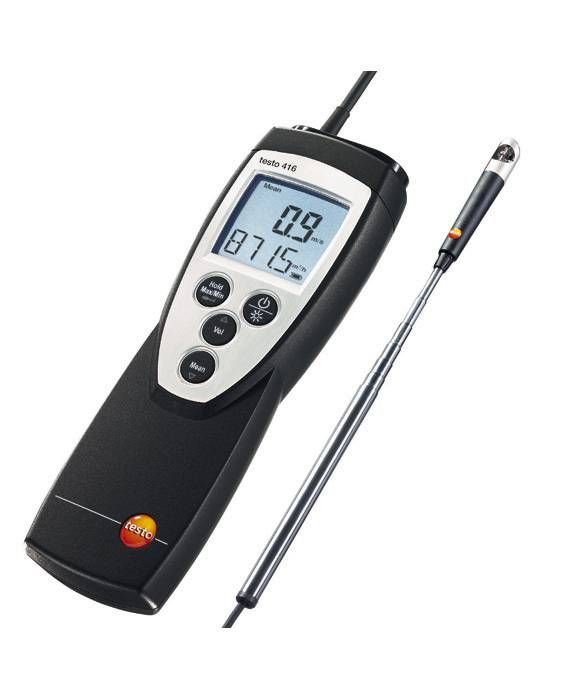
Highly accurate impeller anemometers with large backlit display for fast and clear display of reliable air velocity measurements, fixed impeller anemometer with telescopic handle, telescopic handle up to 890mm, and compact impeller probe with 16mm diameter are the ideal tools for air velocity measurements inside ventilation ducts. With 16mm diameter impeller probe, telescopic handle (up to 890mm long), including batteries and factory report. Inquiries welcome!
Currently, the development of ice sensing technology is quite mature, with dozens of detection principles and methods available. According to differences in principles, ice sensors can be categorized into optical, electrical, mechanical, thermal, waveguide, and other types. Among them, the electrica...
Air quality monitoring station is a highly automated regional air quality monitoring platform, which is capable of real-time and continuous monitoring of multiple pollutants in ambient air. The system is able to cover a wide range of pollutants such as sulfur dioxide, nitrogen dioxide, ozone, carbon...
The negative oxygen ion monitoring system is a monitoring station that automatically collects air cleanliness index data in tourist scenic spots and ecological parks (such as artificial wetlands, ecological scenic spots, botanical gardens, etc.). ).Monitor the negative oxygen ions, temperature, humidity, PM2.5 and other environmental quality parameters in scenic spots....
Handheld radar current meters use K-band radar to measure the flow velocity of rivers, sewage, mud, and oceans without contact. They are unaffected by sewage corrosion and sediment interference, with a maximum measurement distance of 100 meters, ensuring operator safety and making them suitabl...


 Skype
 whatsapp
 mail