Shandong Fengtu IOT Technology Co., Ltd
Sales Manager:Ms. Emily Wang
Cel,Whatsapp,Wechat:+86 15898932201
Email:info@fengtutec.com
Add:No. 155 Optoelectronic Industry Accelerator, Gaoxin District, Weifang, Shandong, China


Sales Manager:Ms. Emily Wang
Cel,Whatsapp,Wechat:+86 15898932201
Email:info@fengtutec.com
Add:No. 155 Optoelectronic Industry Accelerator, Gaoxin District, Weifang, Shandong, China
time:2026-07-10 09:07:38 source:Weather Station viewed:59 time
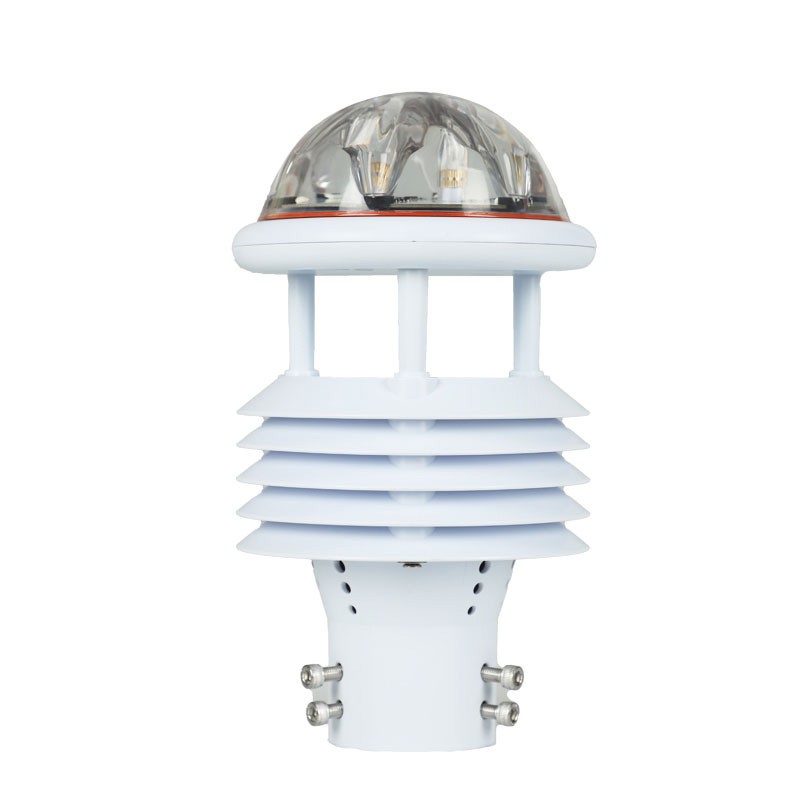
A meteorological monitoring instrument is an intelligent instrument that integrates six standard meteorological parameters into a single device. This device integrates six meteorological elements—ambient temperature, relative humidity, wind speed, wind direction, atmospheric pressure, and optical rainfall—through a highly integrated structure. Unlike traditional distributed meteorological observation equipment, the meteorological monitoring instrument does not require multiple independent sensors; instead, all sensing units are integrated into a compact body, significantly saving installation space and cost.
At the technical implementation level, the meteorological monitoring instrument uses advanced sensing technology for real-time measurement. The device collects various meteorological data through a built-in sensor array, performs signal conversion and calculation through a data acquisition and processing unit, and finally outputs all six parameters to the user at once via a digital communication interface. This design avoids system errors and data asynchrony problems caused by splicing multiple devices, improving the accuracy and consistency of observation data. The device can achieve 24-hour continuous online monitoring of outdoor meteorological parameters, meeting the stringent requirements of timeliness and continuity in meteorological observation.
The meteorological monitoring instrument has applications covering multiple fields. In meteorological departments, it provides fundamental data support for weather forecasting and climate analysis; in agriculture, it helps farmers understand the characteristics of field microclimates and guides agricultural operations; in traffic management, it provides real-time weather information along roads to assist in traffic decisions; and in emergency management, it assists in the early warning and response to severe weather. Some models also have wireless communication capabilities, allowing data to be uploaded to a cloud platform, supporting remote data management and multi-terminal access.
In terms of product form, meteorological monitoring instruments cover two main types: fixed and portable. Fixed devices are typically installed at weather stations, along transportation routes, or on building rooftops for long-term, fixed-point observation; portable devices are easy to carry and temporarily deploy in the field, suitable for mobile monitoring or emergency scenarios. With the development of IoT technology, meteorological monitoring instruments are evolving towards higher integration, lower power consumption, and greater intelligence, becoming an indispensable basic device in meteorological observation networks.
With the socio-economic development and the improvement of people's living standard, people put forward higher requirements for weather forecasting services, and the traditional manual observation can no longer meet this demand, therefore, it is necessary to accelerate the pace of construction o...
Automatic weather stations are widely used weather observation instruments, suitable for monitoring weather data in the region. And with the continuous market segmentation, Windway Technology has launched the portable automatic weather station.FT-BOX series portable automatic weather station is desi...
In ancient times, without modern technology, it was very difficult for people to predict weather changes. But our ancestors demonstrated their wisdom by observing the sky and animal behaviour to predict the weather. Nowadays, with the advancement of technology, we have advanced weather detection ins...
water quality sensor is used to measure common water treatment parameters, such as dissolved oxygen, conductivity, turbidity, pH, temperature, ammonium, nitrate, chloride, etc....


 Skype
Skype
 whatsapp
 mail
mail