Shandong Fengtu IOT Technology Co., Ltd
Sales Manager:Ms. Emily Wang
Cel,Whatsapp,Wechat:+86 15898932201
Email:info@fengtutec.com
Add:No. 155 Optoelectronic Industry Accelerator, Gaoxin District, Weifang, Shandong, China


Sales Manager:Ms. Emily Wang
Cel,Whatsapp,Wechat:+86 15898932201
Email:info@fengtutec.com
Add:No. 155 Optoelectronic Industry Accelerator, Gaoxin District, Weifang, Shandong, China
time:2023-01-28 21:51:36 source:Weather Station viewed:986 time
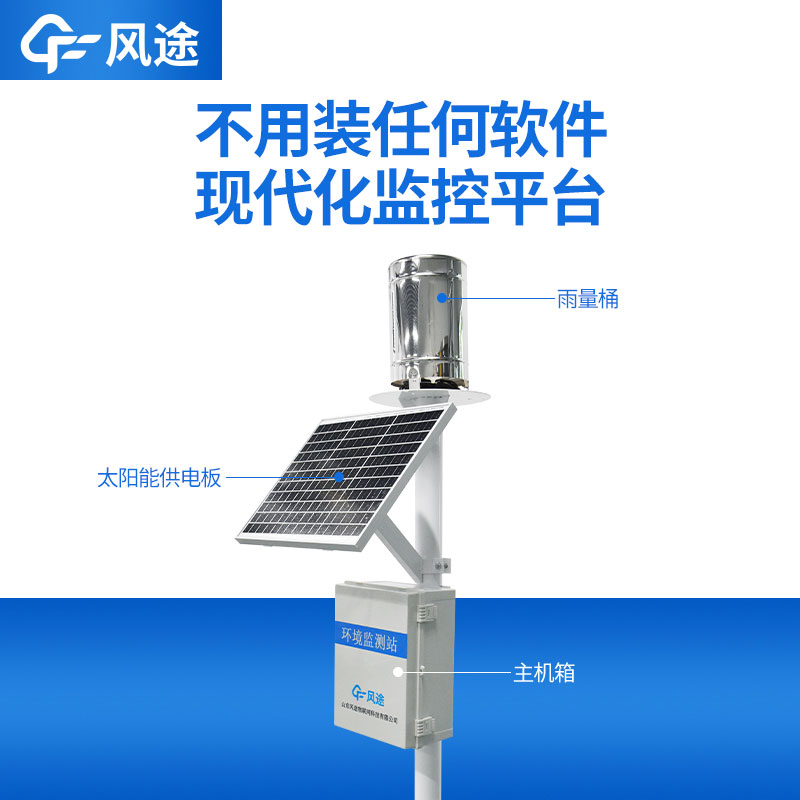
Integrated rainfall monitoring station is an important part of rainfall monitoring, which can realize the observation and analysis of real-time rainfall situation in different stations in the region. Traditional integrated rainfall monitoring data has problems such as data collection and storage difficulties, so an integrated rainfall monitoring station based on cloud platform in wireless sensor network (WSN) mode has emerged. The device uses wireless communication technology to transmit data on mobile terminals and can complete the whole system function without installing any software; through wireless transmission, the rain and water information received by the upper computer is sent to the lower computer for querying and displaying relevant indicators as well as early warning forecast results; the upper computer judges whether over-run or abnormal phenomenon occurs according to the data analysis results.
The integrated rainfall monitoring station has the following advantages compared with traditional rain measuring equipment.
1) Adopting wireless transmission protocol, WSN can well meet the communication needs between multiple stations.
2) Using distributed design, each user has an independent computer operating system, which does not require maintenance or upgrading, reducing operating costs.
3) with a variety of communication interfaces, Zigbee, 3G/4G networking mode and other communication protocols.
4) It can provide remote monitoring service to improve work efficiency and save labor cost.
The integrated rainfall monitoring station mainly includes two major parts: hardware facilities and software system. For hardware facilities: it adopts the modular design idea and consists of a central node and several small base stations, which are used to collect the precipitation information and precipitation distribution status obtained from each monitoring point respectively; for software system: it mainly consists of cloud platform, upper computer and Android APP. At present, the integrated rainfall monitoring station has been successfully applied to several projects, achieving good results and playing an active role in local agricultural production and urban management.
The electronic weather instrument is a portable device that integrates multiple meteorological data, including wind speed, wind direction, temperature, humidity, atmospheric pressure, altitude, thermal index, wet-bulb temperature, wave height, dew point temperature, wind chill index, and GNSS positioning. This highly integrated instrument is widely used in environmental monitoring, meteorological research, third-party testing, and emergency response, providing accurate meteorological data support....
Ultrasonic Wind Speed And Direction Sensor is a wind speed and direction measuring instrument developed based on the principle of ultrasound. It utilizes the time difference in ultrasonic wave propagation to measure wind speed and direction....
Grid monitoring has achieved remarkable results in controlling air pollution. It can accurately locate pollution sources. By constructing a dense monitoring network in different areas, such as dividing ordinary grids in cities, setting encrypted grids in key areas, and arranging irregular grids in s...
Micrometeorology is a subtle change in climate caused by factors such as small-scale topography, such as localised wind, fog and frost. In certain sections of transmission lines, these micrometeorological phenomena may be exacerbated by topographical influences, for example, leading to conductor ice...


 Skype
Skype
 whatsapp
 mail
mail