Shandong Fengtu IOT Technology Co., Ltd
Sales Manager:Ms. Emily Wang
Cel,Whatsapp,Wechat:+86 15898932201
Email:info@fengtutec.com
Add:No. 155 Optoelectronic Industry Accelerator, Gaoxin District, Weifang, Shandong, China


Sales Manager:Ms. Emily Wang
Cel,Whatsapp,Wechat:+86 15898932201
Email:info@fengtutec.com
Add:No. 155 Optoelectronic Industry Accelerator, Gaoxin District, Weifang, Shandong, China
time:2025-12-23 09:26:20 source:Weather Station viewed:472 time
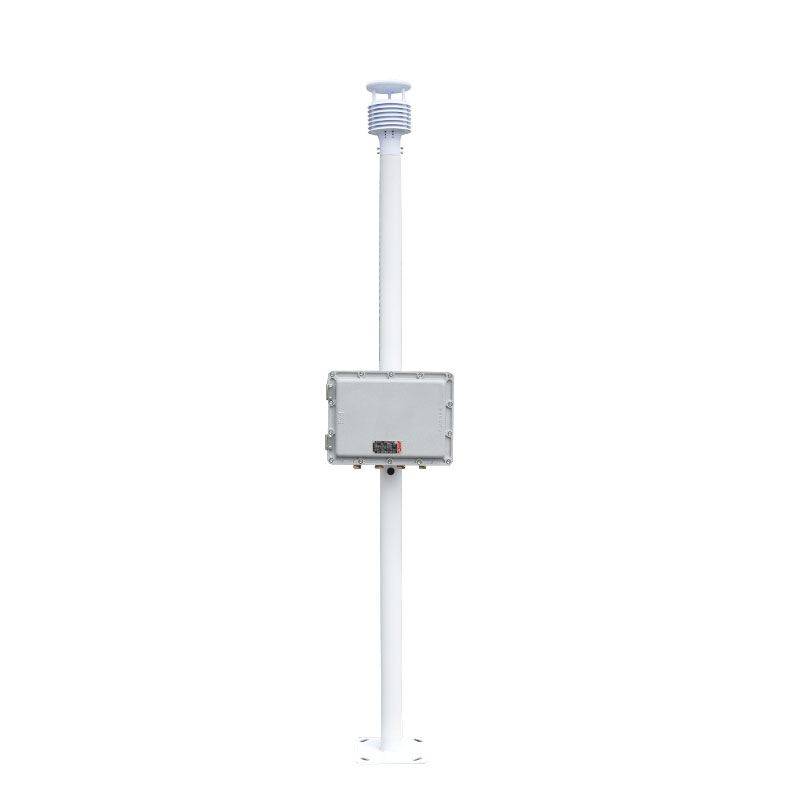
Weather Station Data Logger is an integrated monitoring device specifically designed for hazardous environments such as chemical plants and oil depots. It features a corrosion-resistant, explosion-proof, waterproof, shockproof, and dustproof design. It can monitor five elements: wind speed and direction, temperature, humidity, and atmospheric pressure. With miniaturization and explosion-proof capabilities as its core, it is suitable for high-risk industrial scenarios with limited space.
Weather Station Data Logger is an integrated meteorological monitoring device developed for special hazardous locations such as petroleum, chemical, and oil depots where flammable and explosive gases or dust may exist. These environments place extremely stringent requirements on the safety and reliability of the equipment; any electrical spark or high-temperature point could trigger a serious accident, therefore standard weather stations cannot be directly applied.
The core design concept of this equipment is high-level protection. It adopts an overall design that is corrosion-resistant, explosion-proof, waterproof, shockproof, and dustproof. Specifically, all electrical components, including sensors, data acquisition units, and communication units, are encapsulated in a housing that meets national explosion-proof standards (such as Ex d IIC T6 Gb), effectively isolating the internal circuitry from the external hazardous environment and preventing the equipment itself from becoming an ignition source. Meanwhile, the casing is typically made of corrosion-resistant stainless steel or special engineering plastics, capable of withstanding the corrosive gases commonly found in chemical plants and achieving an IP65 or higher protection rating, ensuring stable operation in harsh weather conditions.
In terms of monitoring functions, it focuses on five key meteorological elements critical to safe production and environmental impact: wind speed, wind direction, air temperature, air humidity, and atmospheric pressure. Continuous monitoring of wind speed and direction helps assess the direction of gas leak diffusion, providing a basis for emergency evacuation; temperature and humidity data are closely related to chemical process safety and pollutant diffusion calculations. All sensors are reinforced for industrial environments; for example, the anemometers employ robust mechanical structures or ultrasonic principles with no moving parts to reduce maintenance requirements.
"Miniaturization + explosion-proof" is another prominent feature. The equipment has a compact design and integrated structure, facilitating installation and deployment at key locations with limited space, such as industrial workshops, small plant areas, tank platform areas, or plant boundaries, enabling precise, grid-based monitoring of micro-meteorological conditions within the plant area. Data is transmitted to the central control room's safety monitoring platform via wired or explosion-proof wireless means, and linked with systems such as toxic and hazardous gas alarms and fire alarms to form a comprehensive factory safety early warning system.
The significance of deploying this weather station lies in transforming weather conditions from uncontrollable environmental factors into quantifiable and predictable safety parameters for production. By providing real-time, local, and accurate weather data, factory managers can better assess production and storage risks, develop scientific emergency plans, and thus shift from reactive response to proactive prevention, comprehensively improving the inherent safety level and risk management capabilities of hazardous industrial sites.
A good atmospheric visibility meter should be able to provide accurate measurement data and stable operation even under adverse weather conditions. It should be robust, easy to install and maintain, and have an intuitive user interface that makes it easy for users to read and analyse data. In additi...
In today's agricultural production, moisture monitoring system is playing an increasingly important role. Like a guardian, it keeps an eye on the condition of the soil and provides farmers with timely and accurate information to help them rationally utilize water resources and improve the yield...
Among the four conditions of agriculture (moisture, seedling, disease and disaster), moisture is a crucial aspect. Good moisture condition can provide necessary water support for crop growth and development, and promote crop growth and yield increase. Therefore, moisture has a very important positio...
Soil moisture is an important parameter in agricultural production, which has an important impact on crop growth and yield. Therefore, understanding and mastering the changing law of soil moisture is of great significance in guiding agricultural production.There are various methods for soil moisture...


 Skype
Skype
 whatsapp
 mail
mail